




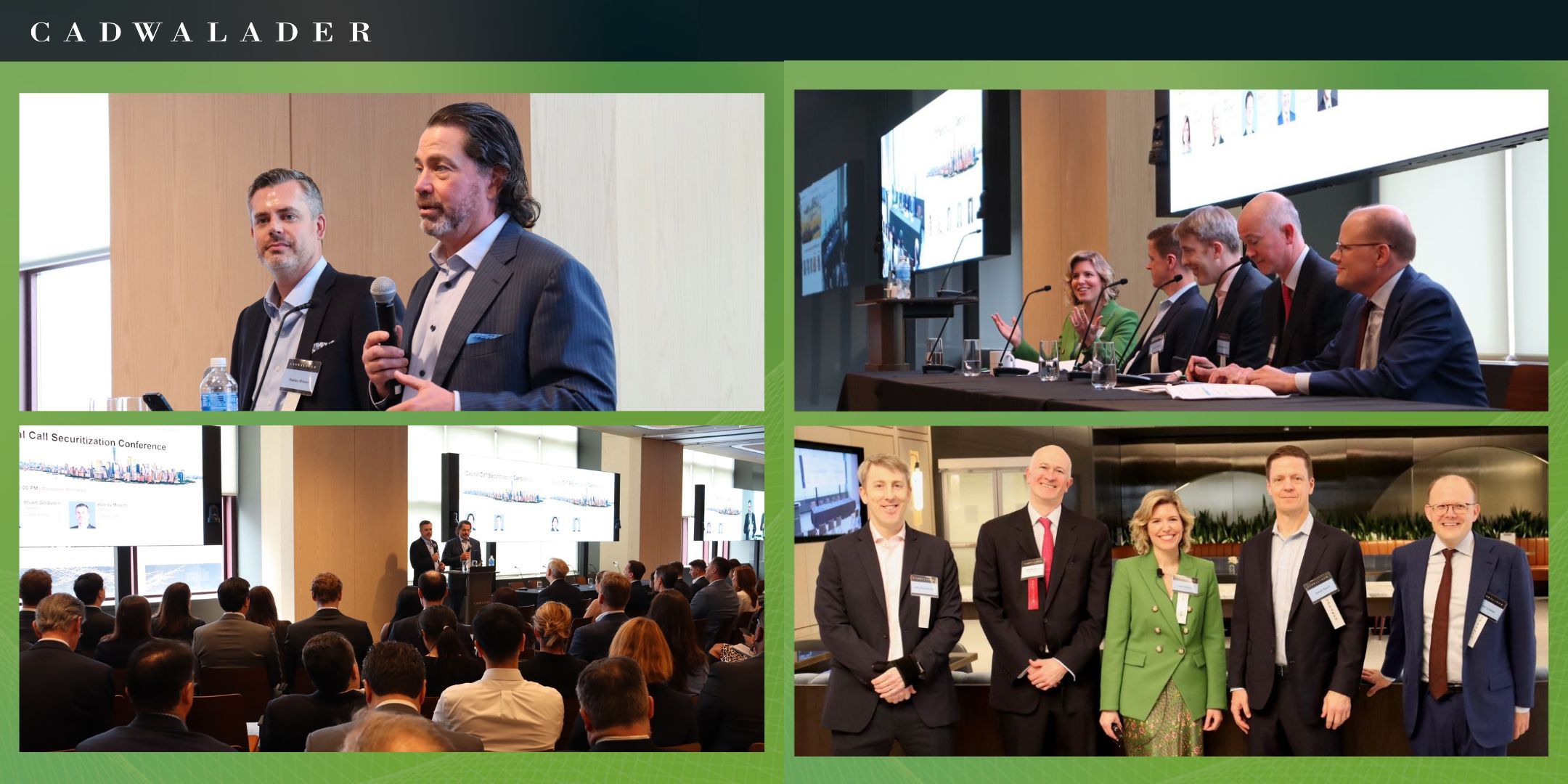
Last week, Cadwalader partnered with Fitch Ratings to host the inaugural Capital Call Securitization Conference at our New York office. The event convened industry leaders and experts for an afternoon of dynamic conversations exploring the latest trends, challenges and opportunities shaping the capital call securitization market.
Read on for key takeaways from the panels.
Defining The Deal: Capital Call Securitization Structures
 |
Associate, Cadwalader |
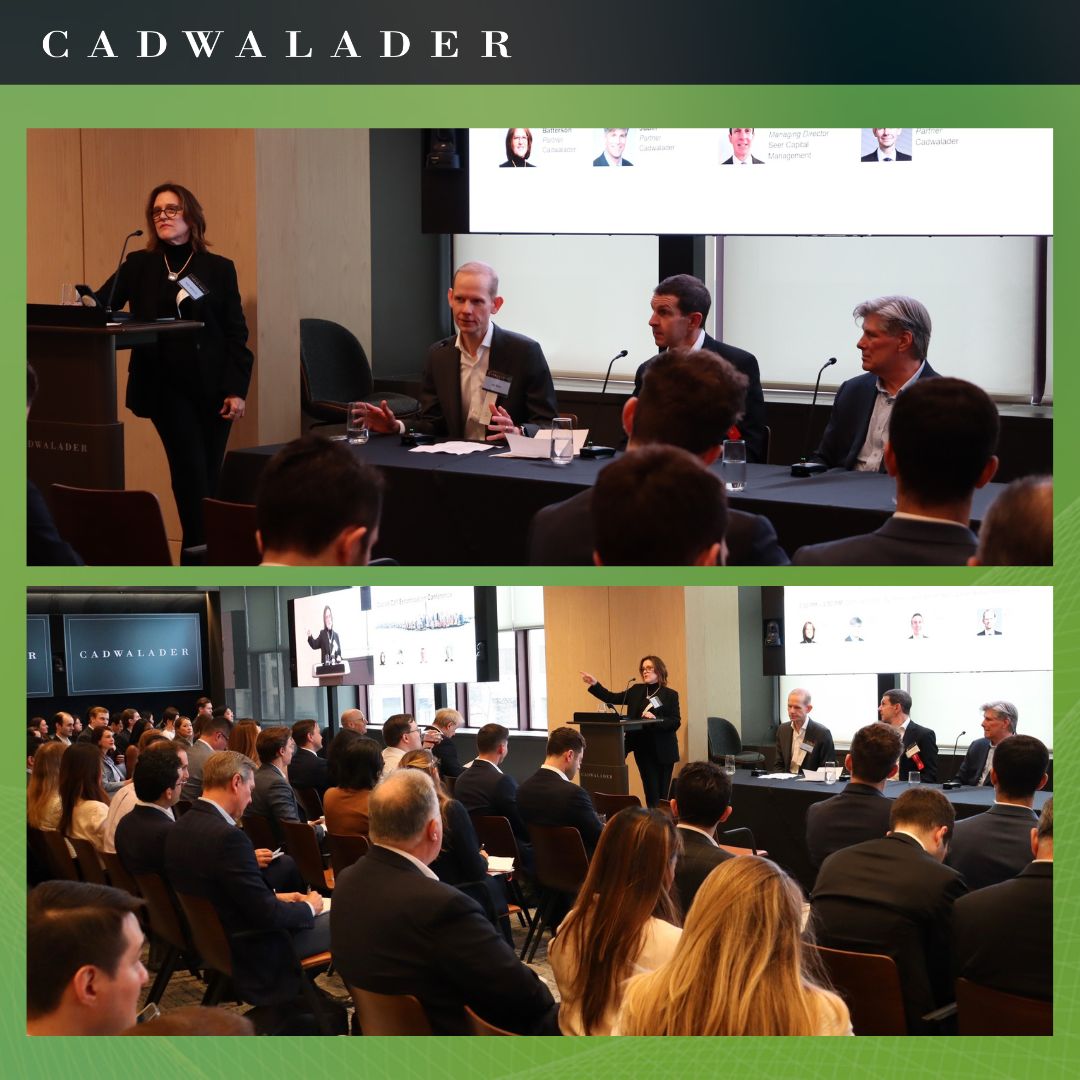
First off, thank you to everyone who attended the Capital Call Securitization Conference. It was great to connect with our clients and other members of the fund finance community on capital call securitization – an increasingly attractive and important capital solution and much more. To lead off the day, fund finance partner Leah Edelboim moderated a panel titled Defining the Deal and was joined by Bob Bengtson, Managing Director at Goldman Sachs; securitization partner Joe Beach; securitization partner Nate Spanheimer and fund finance partner Trent Lindsay for a robust discussion on the basics of securitization, the motivations behind securitization (and, specifically, those of a subscription credit lender), and the various structures parties use in these transactions. The group touched on Goldman’s execution of Capital Street Master Trust Series 2024-1, the first-of-its kind broadly syndicated, publicly rated securitization of subscription credit facilities.
As capital call securitization is still relatively nascent, the panel set the stage with a primer on securitizations at-large, including the legal structuring of a securitization and the motivations behind securitizing. From both a buyer and seller’s perspective, securitization at its core is a very capital-efficient form of holdings assets. But why are banks looking to securitize capital call facilities? Banks are looking at securitization from a number of different angles, some of which include balance sheet relief and, as a natural extension thereof, freeing up capital to meet their clients’ liquidity needs, and others to alleviate portfolio risk. The panel discussed other motivations as well.
With this backdrop, the conversation turned to the specifics of capital call securitization and the panel covered topics from the investor base to the challenges of this particular product with structuring a securitization. In terms of the investor base, securitization allows for other pools of investors (including insurance and other asset managers) to come into this asset class that will continue to grow. The panel also spent some time discussing some of the challenges that subscription credit facilities present in the context of a securitization, chief among them is taking a revolving, short-duration unrated asset and putting it into a rated, funded vehicle. The panel also touched on balancing LP confidentiality concerns with rating agency disclosures and other disclosures that may be made in a securitization. Each of these concerns has been addressed in the public and private structures that currently exist and it will be interesting to see what other solutions come to market to balance the various competing concerns with the business prerogatives of the parties to a deal.
For those unable to attend and/or those seeking to learn more, please feel free to reach out to our team with your capital call securitization questions at CapitalCall@cwt.com.
CRTs & CFOs: Synthetic and Other Non-Cash Securitizations
 |
Associate, Cadwalader |
Fund finance partner Angie Batterson led a discussion on the evolution of the CRT and CFO markets and synthetic securitization trends in the fund finance space. Angie’s panel was joined by Terry Lanson, a managing director at Seer Capital Management LP and Cadwalader securitization partners Gregg Jubin and Jed Miller.
CRT (or SRT?)
The prevalence of CRTs continues to increase among U.S. financial institutions and subscription credit facility lenders seeking capital relief for their risk weighted assets (“RWAs”) and subline loan portfolios. While CRTs are a newer product to the U.S. market, they have been used for some time by European banks with respect to their loan assets.
For those new to CRTs, a CRT is essentially a risk transfer transaction: the bank transfers its credit risk arising from the loan assets on its balance sheet to a third party buyer, and that buyer pays the bank for its losses on those loans in exchange for periodic payments from the bank. The CRT involves the use of a synthetic derivative instrument to synthetically transfer those loan assets, so the bank remains the owner of those loans, which stay on the bank’s balance sheet. Those synthetic instruments are typically in the form of either (1) a bank-issued or SPV-issued credit linked note (“CLN”) or (2) a bilateral credit default swap (“CDS”) between the bank and an SPV. For additional background information, please see our primer on capital call securitization article here and Daniel Meade’s and Jed Miller’s CLN article here.
The panelists discussed that this space is still developing in the U.S., which was demonstrated in part by the non-consensus on the terms used to describe these transactions, including capital risk transfers or capital relief trades (“CRTs”), synthetic risk transfers or significant risk transfers (“SRTs) or just “synthetic securitizations”. Despite the lack of universal agreement on the nomenclature, it is becoming more widely accepted that such transactions have noteworthy benefits to both the banks and investors.
For the banks, a primary motivation to enter into a CRT is to achieve a reduction of the risk based regulatory capital that banks are required to comply with, and that reduction may be accomplished by transferring their lending and credit risks to a third party. A properly structured CRT can result in a decrease of their RWAs by over 80%, which metric continues to attract subline lenders to this growing space.
For the investors, CRTs provide exposure to the loans originated by the banks without having to become a lender or direct participant in those loans. By investing through a CRT, the investors are implicitly getting a junior tranche, and since the loans are generally well performing, the banks can issue that CRT at an attractive spread. The loan assets are also carefully selected and may be subject to a variety of eligibility criteria, concentration limits and other portfolio guidelines (e.g., GP/sponsor “white lists”) that they need to satisfy for inclusion in the portfolio. As a result, this product continues to be in greater demand from an investor base that wouldn’t otherwise have access to the same investments or returns on the loans.
CFO (and Rated Note Feeders)
The CRT should not be confused with a collateralized fund obligation (“CFO”) or its counterpart, the rated note feeder fund (“RNF”). A CFO is typically structured as an SPV that holds an underlying portfolio of private fund interests, and those fund interests become the collateral for a series of rated and unrated notes issued by the SPV to third party investors. Similarly, a RNF will be structured to issue rated debt and an equity tranche to investors, but is itself a feeder fund in a master fund structure.
The key feature of both is the rating component on each product, and the fact that the product is rated attracts certain investors (mostly insurance companies) to participate in the fund investments of the CFO and the investments made by master fund of the RNF. In each case, the rating allows the investor to make such investment without incurring a regulatory capital charge imposed by the NAIC rules applicable to insurance companies. The panelists discussed the significance of the regulatory benefit provided to the insurance companies by investing in these products given the NAIC’s risk based capital and minimum reserve requirements for equity and debt investments.
There is a variety of NAIC criteria used to determine whether the interest is an equity investment or a debt investment, but the common theme is that the RNF needs to have “debt like” features, which among other things, includes having investors other than insurances companies involved in the transaction. The NAIC criteria and related rating methodologies are still developing in this market and the panelists are closely monitoring those industry trends and updates.
For additional information on CFOs and rated feeder funds, please see Gregg Jubin’s and Michael Gonzalez’s CFO article and presentation here.
Capital Call Securitization Market Roundtable Discussion

 |
Associate, Cadwalader |
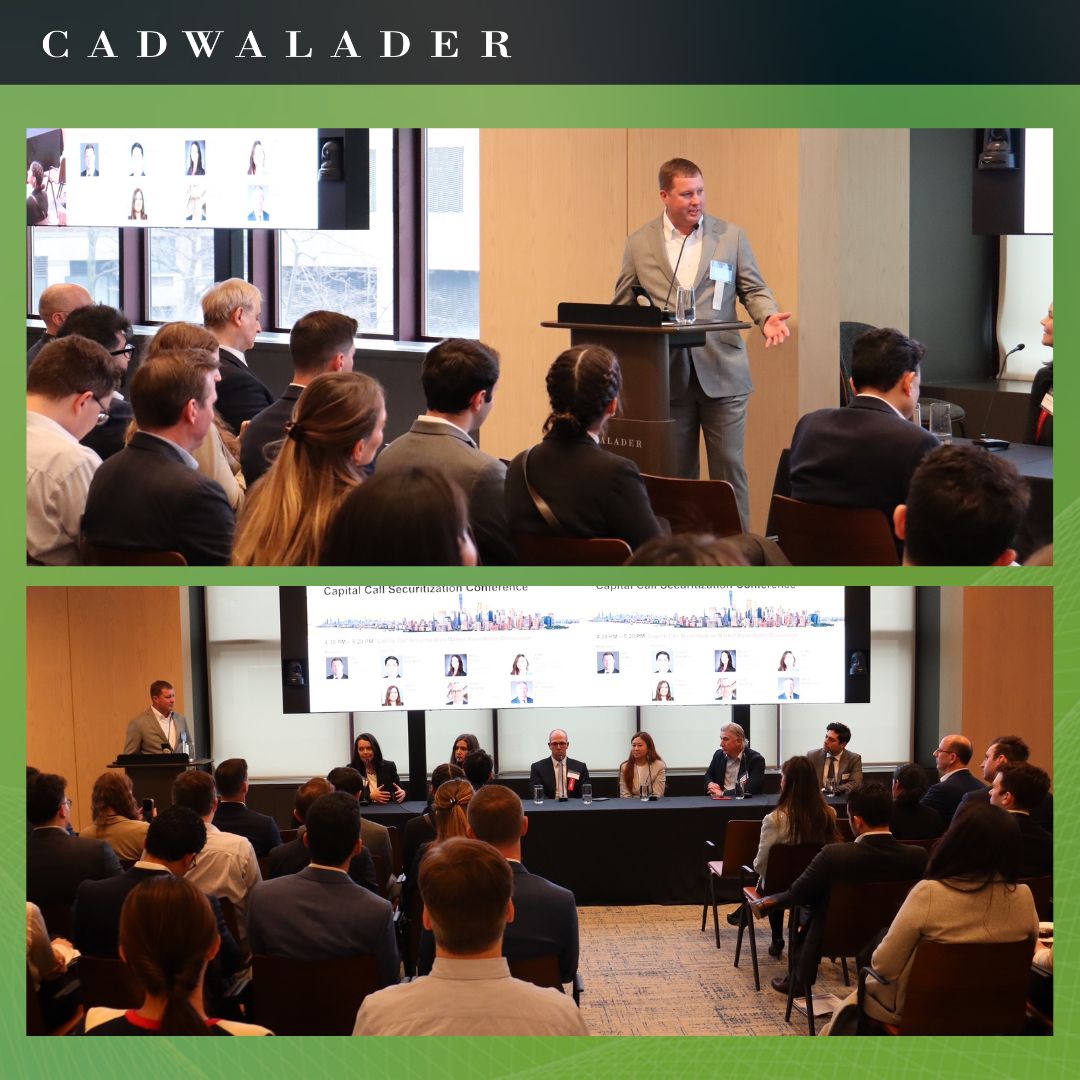
To round out Cadwalader’s inaugural Capital Call Securitization Conference, Cadwalader Partner Tim Hicks was joined by market-leading panelists Missy Dolski, Global Head of Capital Markets, Värde Partners, Vicky Du, Managing Director, Standard Chartered Bank, Slade Spalding, Partner, NLC Capital Markets, David Wasserman, Managing Director, Morgan Stanley, Joyce Fargas, Senior Director, Fitch Ratings and Yezdan Badrakhan, Managing Director, MUFG, for an insightful roundtable discussion on the driving force behind capital call securitizations, a glimpse into Fitch’s rating methodology, and the opportunities that arise from and the key ingredients that will fuel the growth and success of this buzzworthy product.
Driving Force
To give context to the mojo behind fund finance’s hottest ticket item, the panelists touched on a range of considerations, including balance sheet capacity and optimization, and of course, enhancing format, pricing and returns. For certain lenders, securitizing their subscription lending portfolio was a way to get ahead with the expectation that there will be a demand for more capacity on the horizon. Whatever the use case, rationale or strategy however, our panelists were unanimous in agreeing that capital call securitization is a natural evolution of capital raising and ongoing fund finance needs.
Fitch and their Methodology
To date, Fitch has rated approximately 260 capital call facilities and has been mandated on more than 300 deals. The average risk rating is in the AA range but can be as low as BBB-, based on a number of quantitative and qualitative factors such as the creditworthiness and diversification of the limited partners whose capital commitments are the key underwriting consideration for the underlying capital call facility. Ratings are also based on an evaluation of a fund’s general partner and its exposure, the terms of the partnership agreement, incentives for the limited partners, the overall performance of the portfolio and cash flows.
Opportunities and Growth
As with any novel product there has been some reticence, including from sponsors who do not yet perceive its value, notwithstanding the potential to generate lower spreads in the long term. The product also deviates from the intimacy that is associated with traditional, relationship-based subscription lines that allow more scope for flexibility e.g., in the event a waiver is required for a technical default.
Perhaps a testament to the popularity and growth of capital call securitization is the frequency with which borrowers are now asking whether their deals will be part of a securitization. The panelists discussed the importance of repetition and standardization for any growing product, including how to educate and get borrowers comfortable. For example, a key concern from the sponsors’ perspective is confidentiality, which is structurally mitigated by reducing information being shared to blind pools. The panelists also emphasized the importance of discussing workable solutions for both sides, including with respect to liquidity and pricing. One panelist also remarked on the importance of recognizing that the traditional revolver model may not always yield the best returns on the basis of utilization and efficiency, and for this reason, we must continuously look to the next frontier to improve returns.
What’s Next?
At the forefront of this exciting space, we are seeing an alignment of securitization and fund finance specialists (especially at Cadwalader) who are working rapidly to set up the “plumbing” that is the foundation of capital call securitization. While new transactions can take on average a year to close, it can feel like the pressure is on to make them count. Nevertheless, it is clear that the market driver for this product is based on an increase in fundraising and growth in privatization, and our space remains rife with opportunity and incentive to cross-skill. As Mike Mascia noted in his chapter of this year’s GLI Pink Book, “All of Finance is now Fund Finance.”