




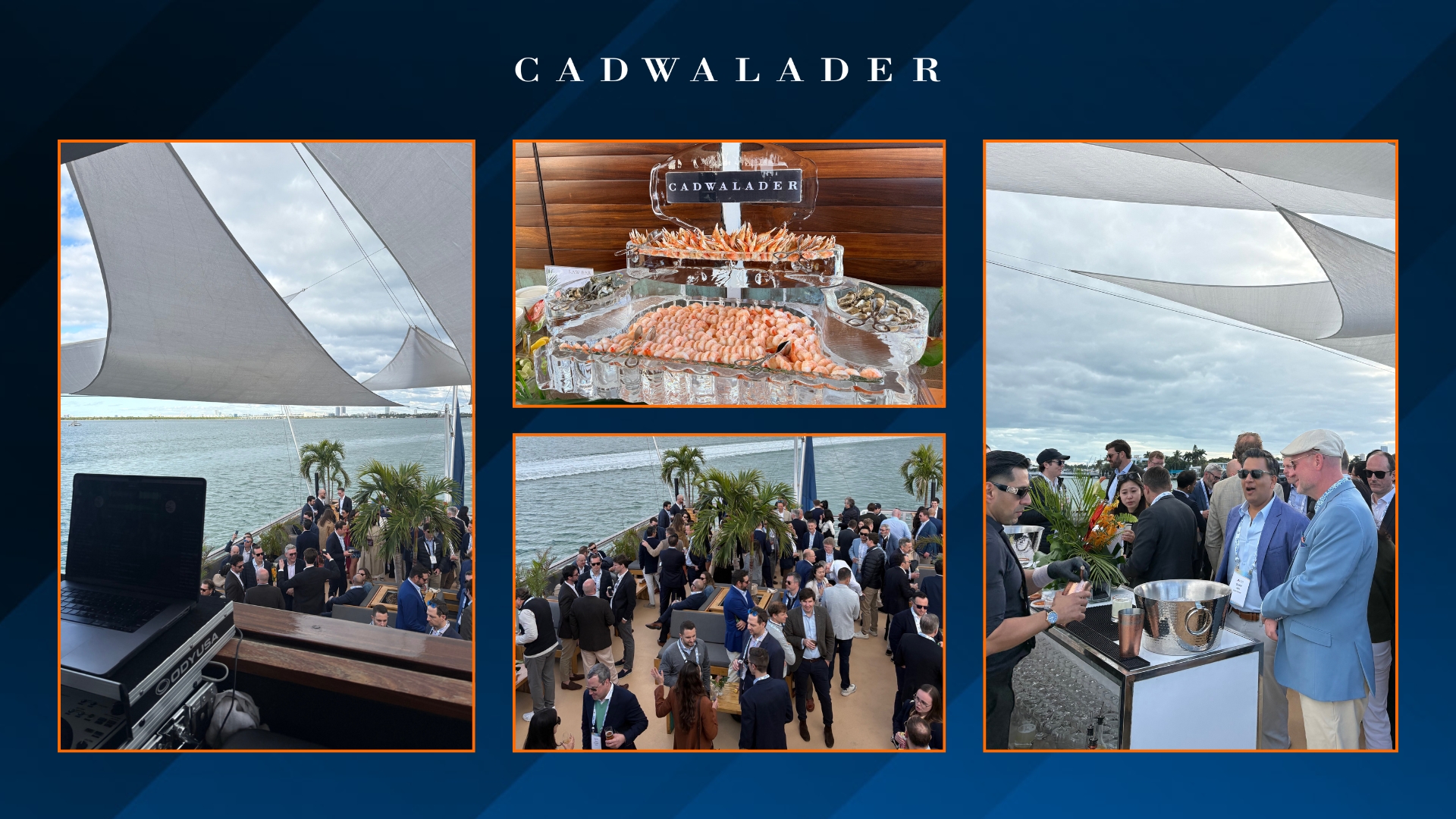
Cadwalader had a wonderful time at the Fund Finance Association's 15th Annual Global Fund Finance Symposium in Miami.
Read on for key takeaways from some standout panels!
Fund Finance Market Update (Macro)
 |
Counsel - Washington |
The 15th Annual Global Fund Finance Association Symposium opened with the “Fund Finance Market Update (Macro)” panel moderated by John Paul Igoe. He was joined by Will Canty Collins, Head of Fund Finance at The Carlyle Group, Oliver Dunsche, Managing Director at Deutsche Bank, Mike Henry, Managing Director at U.S. Bank, Marc Pinto, Global Head of Private Credit at Moody’s Ratings and Richard Sehayek, Partner at Ares Management.
Below are the key takeaways from the session, organized around four themes: 2025 market trends, fundraising and distribution dynamics, macro and regulatory drivers and the outlook for 2026. Overall, the panel suggested that the fund finance market has emerged from a period of stress more diverse, more interconnected, and more structurally sophisticated - positioned for continued expansion into 2026, provided growth remains anchored in disciplined underwriting, transparent documentation and responsible innovation.
- 2025 in Review: A Deep, Still‑Growing Market – Increasingly Specialized
Panelists broadly agreed that 2025 has been another year of growth and maturation for fund finance, with a clear shift away from “jack of all trades” participation toward more defined institutional roles and niches.
Risk appetite remains strong, even as products evolve.
- Both U.S. and European bank lenders emphasized that their core risk appetite for traditional subscription facilities has not diminished.
- What has evolved is the definition of “fund finance”: bilateral deals are far more bespoke, often blending subscription, NAV, and hybrid features and secured by a combination of uncalled capital and asset‑level collateral.
- Several banks reported double‑digit portfolio growth in 2025, with expectations for another solid year into 2026, albeit at more moderate growth rates.
Market discipline and specialization are replacing the ‘everyone does everything’ phase.
- Alternative credit providers and insurers are no longer attempting to compete across the full spectrum. Instead, they are concentrating on narrower or more esoteric strategies, GP‑level facilities, management company financings, and structured solutions such as securitizations of subscription and NAV portfolios and risk tranching.
- Bank lenders, by contrast, are concentrating on their core offerings (traditional subscription facilities and rated or syndicated structures) while selectively moving up the complexity curve where balance sheet and regulatory treatment allow.
Innovation is increasingly structural, not purely pricing‑driven.
- The panel highlighted continued growth in NAV and hybrid facilities across private equity, private credit, real estate and infrastructure; the expansion of evergreen and semi‑liquid vehicles; the use of CFO‑style securitizations; and multi‑tranche structures designed to allocate discrete slices of risk to different capital providers, including banks, insurers, alternative credit, sovereign wealth and pension plans.
- While innovation is broadly viewed as positive, several panelists cautioned that additional complexity must be justified by a clear commercial objective, such as materially reducing the cost of capital or unlocking larger facility size.
- Fundraising, Investor Behavior and Implications for Fund Finance
The panelists drew a direct connection between the evolving fundraising environment and the way fund finance facilities are being structured, priced and underwritten.
Slower, more selective fundraising is reshaping structures.
- Sponsors noted that, at the top tier, access to bank capital remains abundant. Large managers can still secure sizeable individual lender holds (often $500 million or more and in some cases $1 billion+ from a single insurance company or alternative capital provider). That experience is not universal: middle‑market and first‑time managers are encountering a more challenging environment, particularly around pricing, structural flexibility, and disclosure requirements.
- To reduce the friction of repeated fundraising cycles, sponsors are increasingly turning to SMAs anchored by very large single‑investor commitments, as well as evergreen and open‑ended fund structures that avoid frequent vintage launches.
SMA and evergreen vehicles now represent a meaningful share of lender portfolios. One U.S. bank noted that SMA exposure has grown to approximately 15% of its fund finance book, with a notable increase beginning in the second half of 2024 and continuing into 2025. These vehicles tend to be highly bespoke, often featuring opt‑out, transfer or redemption rights that demand careful legal and credit analysis. Evergreen and semi‑liquid funds, in particular, introduce distinct risk considerations around capital call sequencing, redemption mechanics and stress behavior.
LPs are more assertive - and side letters are under a sharper lens. A challenging fundraising backdrop has emboldened LPs to demand more protective terms and side letter provisions, including limitations on liability and enhanced information rights. Lenders are reacting by scrutinizing side letters more closely, reassessing what is truly “market” in terms of investor protections, and in some cases, walking away from deals where core structural protections (e.g., a required investor consent letter in an SMA) are not achievable.
Ratings and transparency are unlocking additional sources of capital.
- Demand for ratings (public, private and so-called “investor subscription credit ratings”) continues to increase, particularly in the context of NAV facilities and rated note feeder structures. For U.S. insurance investors, NAIC capital treatment is a key driver of this trend. Panelists note that the NAIC working groups are actively reviewing and challenging private ratings, a process expected to encourage greater use of multi‑rating structures and further discipline and standardization in rating methodologies.
- Panelists also observed that ratings have enhanced transparency in a market that can otherwise be opaque and media‑sensitive, and are increasingly essential to making the asset class scalable for insurers and other regulated investors.
- Macro and Regulatory Drivers: Capital, Liquidity and Pricing
Macro-economic conditions and regulatory developments, across the United States, Europe and other jurisdictions continue to shape who provides capital to the fund finance market, at what price, and on what terms.
Pricing pressure is evident, but underwriting standards have held. Spreads and fees on subscription facilities have compressed materially over the past 12 to 18 months, with average margins across large portfolios declining. Sponsors, particularly larger platforms, are experiencing a favorable borrowing environment: facilities that previously required syndicates of 8 to 10 banks can now often be fully supported by 3 or 4 lenders, each taking substantially larger holds. Despite this competitive dynamic, panelists emphasized that structural protections and valuation discipline remain central. Leading banks, they noted, are prepared to step back where key protections are diluted, and the market has not, in their view, experienced an erosion of underwriting standards.
Diverging U.S. and European regulatory paths are reinforcing differentiated roles.
- European banks continue to face comparatively conservative capital and regulatory constraints, while U.S. capital requirements are widely viewed as showing signs of gradual easing. Panelists expect this divergence to encourage U.S. banks to compete aggressively on standardized, broadly distributed transactions - often driving looser structures and tighter pricing - while pushing European banks toward more bespoke, complex, and higher‑value structuring roles where they can lead and be compensated for technical nuance.
- In Europe, public ratings, as well as quasi‑public “investor subscription credit ratings,” may also provide tangible capital relief, further incentivizing the use of ratings‑based solutions.
Balance sheets are being actively managed through partnerships.
- Alternative lenders and banks are increasingly functioning as partners rather than pure competitors.
- Banks typically originate and retain senior or revolving tranches that align with their capital and liquidity frameworks. Alternative credit funds and insurers provide last‑out or mezzanine tranches, equity‑like notes within CFO structures, and back‑levered or capital‑relief solutions. European banks, in particular, are using these partnerships to manage risk‑weighted assets and balance sheet constraints while continuing to expand their fund finance activity.
- Panelists emphasized the growing interdependence of the ecosystem, with banks, insurers, pension funds, sovereign wealth funds, and private credit managers increasingly participating together in multi‑tranche structures.
Regulators are engaged and broadly supportive, but focused on responsible growth.
- Moody’s noted that regulators globally are increasingly engaged with private credit and fund finance and generally view the asset class as a constructive contributor to capital formation. Key regulatory themes include NAIC scrutiny of private ratings and capital charges on insurer‑held assets, Bank of England stress testing of asset managers’ private credit portfolios, and anticipated U.S. Department of Labor guidance on expanding private asset access to 401(k) plans, potentially accelerating the realization of private credit.
- The message: regulators are engaged and cautiously supportive of continued growth, but in a way that passes not just short‑term volatility queries, but the eventual full‑cycle stress test.
- Outlook for 2026: More Growth, More Innovation, More Segmentation
In closing, the panelists offered concise views on what the next 12 to 24 months may hold for the global fund finance market. Partnerships and simplicity will remain differentiators. From the sponsor perspective, the preference is still for structural simplicity whenever possible - complexity is welcomed only where it clearly solves a real problem (size, cost, or specific investor constraints). From the lender perspective, deep, multi‑product relationships with key sponsors are increasingly important as facilities become larger and more bespoke. Panelists expect to see fewer, deeper core relationships for sponsors with their lead banks and alternative capital providers, and continued broadening of the lender base at the transaction level, as large deals require multiple sources of capital to come together.
Growth continues - but with sharper segmentation. Most expect another strong growth year through 2026, particularly for top‑tier sponsors and well‑rated structures. The market is increasingly segmented by sponsor quality and track record, product type (core sublines vs. NAV/hybrid/GP facilities vs. structured solutions), and provider type (banks vs. non‑banks vs. insurers). Each capital source is settling into more clearly defined roles, which panelists viewed as a healthy evolution away from undifferentiated competition.
More tranching and structuring sophistication ahead. Panelists expect continued expansion of multi‑tranche fund finance structures with clear senior/mezz/equity stacks, rated note feeders, including multi‑strategy feeders that give insurers “the best of” a manager’s platforms, and securitizations of fund finance portfolios. These trends are likely to be accompanied by more frequent use of multiple ratings within a single transaction and closer alignment between product design and ultimate holders of the risk.
Valuation and documentation risk will be the key pressure points. Several panelists highlighted two areas that deserve heightened attention as the cycle matures: (i) valuations, particularly in private credit NAV structures, where there can be a “par until it’s not” mentality, which can mask underlying volatility; and (ii) investor documentation (LPAs, side letters, redemption terms), where incremental concessions to LPs can accumulate into meaningful credit exposure if not carefully diligenced and structured. Lenders are responding by relying more heavily on internal sector expertise, challenging valuation methodologies, and insisting on dynamic, forward‑looking covenant frameworks.
Keynote: Serena Williams
 |
Counsel - Charlotte |
The 15th Annual Global Fund Finance keynote speaker, Serena Williams, opened by reflecting on her journey from a young girl with a tennis racket to a global icon, entrepreneur and investor, emphasizing the important role her family played in shaping her values and resilience. Raised in a close-knit household, she credited her father’s bold vision and belief, along with her mother’s discipline and attention to detail, for developing her mental toughness, humility, and work ethic. Williams highlighted that tennis taught her how to perform under pressure, take full responsibility for outcomes and be a leader — skills that seamlessly translated into business and investing.
Preparing early for life beyond sports, Williams pursued entrepreneurship and venture capital, ultimately founding a firm committed to investing in strong founders and expanding access for women and underrepresented communities. Prior to starting her venture capital fund, Williams began by investing as an angel investor out of curiosity about technology and innovation where she learned early on about the importance of due diligence and risk that is associated with being an investor. Despite the challenges she faced, she was not deterred. Due to her upbringing, Williams has been able to apply her lessons from elite athletics — such as adaptability and performance under pressure — to the world of investing.
Her transition into venture capital was intentional, rooted in a desire to actively shape the future rather than passively invest. This transition was born from a pivotal moment when Williams was attending a conference, and she learned how very little funding flows to women and people of color, motivating her to start her firm with a goal to address this imbalance. Her investment philosophy centers on backing strong founders with a focus on innovation, particularly in AI and technology. Williams has seen venture capital as a continuous learning process, approaching each founder meeting as an opportunity to gain knowledge and remain intellectually humble. She underscored that leadership requires accountability, resilience, and the courage to embrace discomfort, concluding that true growth — whether in sport, business, or life — comes from leaning into challenges and owning responsibility.
Overall, as this year’s keynote speaker, Serena Williams provided the audience with a real-world lesson of bravery in a new landscape, sustained humility, the courage to lead and relentless curiosity. Collectively, these themes underscore how adaptive leadership and lifelong learning enable success across different professional domains.
Trends and Innovations in NAV Lending
 |
Counsel - New York |
This panel provided a brief recap of the 2025 market and then discussed recent and expected trends in the NAV side of fund finance. The panel provided different perspectives on the topic, with lawyers Dylan Glazier and Leon Stephenson, partners at White & Case and Reed Smith, respectively, joined by Richard Chiu from Mizuho, Zach Kapellakis from Standard Chartered Bank, Michael Hacker from AlpInvest and Raul Llanes from BCI Capital.
The discussion mainly focused on the flexibility of NAV structure to address differing client needs and the growing innovation in the industry as lenders and borrowers develop varying products to meet those needs. There were several specific products and trends mentioned, such as the growing popularity of evergreen funds (noted as being driven by investor appetite), the continuing use of continuation vehicles (with exit opportunities remaining a moving target), and the use of preferred equity structures. However, most of the discussion highlighted NAV products generally as providing a platform that more and more funds and lenders are becoming comfortable with and that can be structured to provide solutions to a variety of funding and portfolio scenarios, including when used alongside the more traditional subscription facilities.
One panelist noted that the guidance provided by ILPA (in July of 2024) has led to broader acceptance of NAV financing, as GPs discuss the use of NAV products with their LPs, and work with LPACs to make sure they understand how the products are being used (even noting that dividend recaps can provide needed liquidity so long as they make sense with the investment portfolio). The panelist also noted that the confrontational stance with ILPA that was largely portrayed at the time was overblown.
One challenge presented by continuing innovation is getting everyone up-to-speed as new NAV products, solutions and collateral structures are developed. One panelist even noted that educating their law firms on new products and structures can be a challenge when transactions are moving fast – CWT is happy to propose a solution to this challenge (i.e., call us).
The broader trend noted by the panelists, both during the course of the discussion and when prompted at the end of the panel to give their thoughts on the longer term (i.e., next five years) prospects of the NAV industry, was a firm belief that NAV is here to stay. There are more competitors entering the space, both on the bank and non-bank side, but the panelists said that there would continue to be opportunities for the different types of lenders to work together to find solutions for borrowers. One panelist said that, just as subscription financing did, NAV would become more mainstream as lenders and borrowers look at the fund lifecycle holistically and develop financing solutions for the entire lifespan of the funds.
Global Bank Syndication Outlook: Liquidity, Capital Pressure and Market Evolution
 |
Counsel - New York |
This year, moderator Cecilia Luk (Sumitomo Mitsui Trust Bank) was joined by seasoned panelists Wendy Cai-Lee (Piermont Bank), Anthony Cha (MUFG Securities), Matt Hill (Commonwealth Bank of Australia), and Christopher Montgomery (King & Spalding) to discuss key syndication trends in 2025 and what to expect in the upcoming year.
In 2025, the syndication market remained robust, with strong liquidity and compressed pricing due to an influx of capital and delayed fundraising. Agent banks are taking larger bilaterals for longer periods, participants are writing larger tickets and we are seeing longer-term transactions (3+ years), in each case driven by the push from sponsors.
We are seeing progressively more creative facility structures, with non-bank lenders entering transactions, term and NAV facilities continuing to gain traction, as well as an uptick in rated note feeders to facilitate the influx of insurance capital. The inclusion of tranche B facilities is also becoming more popular as sponsors seek to maximize liquidity. Despite compression in margins, liquidity is strong, and lenders are chasing volume.
Regional banks and challengers are finding opportunities in the market, with efficient capital deployment giving them an edge. The importance of speed and willingness to underwrite complexity is growing, with sponsors valuing quick execution and transparency.
New entrants, including challenger banks and non-banks, are changing the market dynamics and lenders need to be prepared to adapt. The syndication process is becoming more robust, however participants are becoming increasingly sophisticated and asking increasingly complex questions, while sponsors continue to push for speed and flexibility.
Looking ahead to 2026, constraints on capital and risk weighting limitations may impact the market. However, lenders are expected to continue innovating and finding creative solutions to meet clients' liquidity needs. Pricing is expected to level off, and relationships will remain key in the market.
Private Credit Back-Leverage
 |
Counsel - New York |
The Panel was hosted by Jeremiah Wagner (Latham & Watkins), with panelists Amanda Schimmel (Blue Owl Capital), Christopher Desmond (Dechert LLP), Erik Anderson (ING Capital), and Adam Summers (Fried Frank).
The panel started by defining back-leverage broadly as borrowing against credit assets (as opposed to capital commitments or equity) and encompasses ABL, CLO, NAV, repo, and hybrid structures. Hybrid facilities have a borrowing base which includes both uncalled capital and assets; ABL & NAV were historically distinct structures but are now often interchangeable as both allow for borrowing against pledged assets or overall portfolio value; Repo facilities have different documentation and are often handled by trading desks with specific regulatory and collateral considerations.
Back-leverage is used to enhance returns, manage fund liquidity including planning for redemptions, tailor liquidity and leverage according to fund and asset type. Back-leverage use is adjusted based on fund type and structure, especially for funds that permit regular redemptions. Benefits of back-leverage include flexibility and depth of available markets and the ability to combine subscription lines with recourse/non-recourse facilities.
Back-leverage evolved from warehousing broadly syndicated loans toward adopting securitization and structured finance features in private credit. The asset mix within funds drives the suitability and structuring of back-leverage.
There has lately been an increased use of ratings in ABL and fund finance structures which has expanded the pool of potential investors to include insurance companies, pension funds, and international banks. Ratings criteria drive collateral quality tests and structural changes, enabling more investor participation but introducing additional regulatory and operational complexities.
Back-leverage facilities have generally performed well through market volatility, aided by strong partnerships between borrowers and lenders. The panel emphasized the importance of relationship-driven negotiations with managers tending to favor lenders that act as good partners during downturns. Rated facilities are perceived as less prone to adverse actions in market dislocations due to defined rating criteria. The panel emphasized the importance of diversification (assets, financing, and banking partners), understanding the complexity and limitations of facility terms, building relationships with lenders, and preparing and structuring funds with financing in mind from inception of the fund.
Insurance in Fund Finance
 |
Special Counsel - New York |
 |
Counsel - New York |
This panel discussed the increasing role of insurance companies in fund finance and the different ways insurance capital is being deployed in this space. The panel was moderated by Dylan Wiltermuth (Carey Olsen) and featured Angie Batterson (Cadwalader), Jeremy Deutsch (Neuberger Berman), Blake Gilson (Proskauer Rose), Matt Hansford (Barings) and Harsh Shah (Citi).
The Current Landscape
The panel kicked off with a discussion about the diversified investment platforms of insurance companies, their role in private credit NAV lending and private equity secondaries, and the more recent trend of insurers accessing the private credit markets through CFOs, rated note feeders and other rated, structured debt products. These rated products allow insurance companies to receive more favorable capital treatment relative to equity investments, while still maintaining the ability to access diversified private market assets. The panel explained that the diversity of insurance company lending is driven by their complexities and needs. For example, insurance companies often seek products to match their life insurance and annuity payments – this means fund finance transactions with higher advance rates, longer duration tenors (often exceeding 10 years) and larger upfront commitments.
Ratings and the NAIC
The panel also discussed that such products still need to be ratable by a nationally recognized rating agency, and commented on the increased ability of such rating agencies to provide investment grade ratings for a much wider range of fund finance products compared to prior years. The panel further noted that the National Association of Insurance Commissioners is still working on the development of clearer rules relating to the bond definition and risk based capital requirements.
Another Tool in the Toolkit for GPs
The panel agreed that the access to insurance company capital in fund finance provides sponsors and GPs with another tool to find flexible, long term solutions to meet their funding needs. When compared to traditional bank lenders and other forms of non-bank lenders, the growing availability of ratable products through which the insurance companies can invest provides a unique and differentiated source of that funding.
Financing Structures for Mid-Market Managers
 |
Associate - London |
Panelists: Josh Cherry-Seto (Velocity Capital Advisors), Richard Facundo (Loeb & Loeb), Trevor Freeman (Axos Bank), Justin Gaudenzi (Ropes & Gray) and Jan Sysel (A&O Shearman)
The panel discussion focused on the liquidity needs of mid-market managers, and how these compare to large-cap funds. The distinctive features of mid-market managers that were discussed included:
- Operational resources: unsurprisingly, mid-market managers are not able allocate as much time and resource to building their internal fund finance capabilities as their larger counterparts. As a result, building relationships with finance providers and advisors that can present and tailor available options are crucial in the mid-market space, and managers are looking for trusted partners to guide them throughout this process.
- Capital providers: the panelists discussed the growing presence of insurance capital in fund finance, but noted insurers would typically look to invest in facilities provided to (or feeder vehicles operated by) large-cap managers, so mid-market managers may not be as well placed to take advantage of the availability of insurance capital. The growing importance of obtaining ratings for facilities and feeders through which insurers can invest was also noted, and the panelists mentioned that the managers would typically be expected to bear the costs of ratings.
The panelists also outlined the key fund finance products available in the market, including subscription line, hybrid, co-invest, management line and NAV-facilities, and continuation vehicle financings, noting that the type of products may not differ much in the mid-market as compared to the large-cap space and that there is a suitable product for each stage of a fund’s life. However, the panelists discussed how each of these products is typically tailored to the specific needs and features of the relevant fund, so products within the same range can come in many different shapes and forms.
Co-invest facilities supporting capital contributions by fund executives were discussed as an increasingly important product in the market, noting the importance of sponsors showing that they have “skin in the game” as a tool for attracting investor capital in a challenging fundraising space. It was noted that these types of facilities can vary significantly and be provided by a bank’s private wealth division (typically to individual employees) or corporate finance division (typically to an SPV pooling employee capital and co-invest interests). It was noted that such facilities are typically supported by a guarantee from the relevant fund as well, as well as security over the relevant co-invest interest(s), with the lenders’ main source of repayment being distributions to the relevant co-invest vehicles.
GP Perspectives
 |
Special Counsel - Charlotte |
The GP Perspectives panel was moderated by William Wallace, managing director and head of origination and execution of fund finance at SMBC, with panelists Cristiano Machado, managing partner at Brookfield, Nathalie Majlis, managing director at Blackstone, Joanna Shing, managing director at Oaktree Capital Management, Josh Ufberg, senior managing director of Blue Owl Capital, and Steve Wilmann, partner and treasurer at TPG.
The panel covered a range of topics from consolidation within the industry, consistency of loan documentation, matching lenders with strategies and what sponsors need for successful relationships with their lender partners.
When discussing the consolidation of firms, the conversation focused on (i) the importance of merging firms to maintain their autonomy to continue to perform as they were before and (ii) introducing synergies that benefit the overall performance of the combined entity, in each case so any merger is complementary to performance prior to the merger. One synergy that is clearly top of mind is consistency in loan documentation across the portfolio to ensure ease of execution from the sponsor side while also having a consistent product with each sponsor’s lending partner.
The panel was very supportive of the idea of matching their lender partners with fund strategies that fit each lender’s goals (whether a more conservative approach with lower pricing or higher risk appetite that commands higher spreads) and noted how the FFA Global Symposium is a key tool in making those determinations that will shape strategy for the rest of the year. When making these determinations the panel agreed that pricing remains important but also noted how key it is to have lenders that consistently deliver, regardless of hurdles presented.
Indeed the panel noted how it rewards its reliable partners with better terms and opportunities (as one panelist put it, rewarding the lenders that have created a healthy relationship from “eating their vegetables” by giving those lenders “candy” as a reward). It was ultimately clear that lenders who consistently deliver for sponsors through smooth transactions enjoy the strongest relationships.
Securitization and Bank Balance Sheet Management Tools
 |
Associate - London |
The panel discussed a broad church of topics on securitization, including the use of securitization structures — SRTs/CRTs and CFOs in fund finance, regulatory capital and balance sheet optimization, ratings perspectives, structuring trends and general outlook.
The panel broadly concurred on the following key takeaways:
- Innovation and convergence of fund finance and securitization are the buzz words. Whilst those products are still nascent and developing, traditional boundaries between fund finance and securitization continue to blur and we continue to see increasing convergence. At the moment products seem to be developing individually however, the panel expects an emergence of more standardized and repeatable structures gaining broader market adoption.
- Regulatory environment continues to play a key role. Recent changes in the US are viewed as particularly encouraging, especially in respect of the STR/CRT trades. In Europe, there are signs of similar trends with recent proposals to relax the rules around EU securitization framework. One ongoing challenge is the treatment of cross-border structures, where transactions may inadvertently fall within the scope of U.S., UK, or EU securitization regimes. The panel anticipates that some softening of the rules, in particular as regards the due diligence, reporting requirements will further translate in the growth of securitization in the fund finance space.
- SRT/CRT trades (i.e., synthetic risk transfers — often documented via credit default swaps or guarantees — without selling the underlying assets and which are used to achieve regulatory capital relief and help banks reduce risk-weighted assets) are becoming established balance sheet tools. These structures gained traction in 2022 and 2023 amid tight liquidity conditions. While market liquidity has since improved, the panel expects SRTs and CRTs to play an increasingly prominent role should regulatory capital relief become again more compelling.
- CFO trades (i.e., structured finance transaction where a portfolio of private fund interests is transferred to a securitization special purpose entity and is entity issues rated notes debt and equity to investors which secured by the cash flows from the underlying assets) has experienced a sharp uptake. Innovation in this space continues at pace, particularly around how sponsors retain the first-loss or equity tranches. Increasingly, these positions are structured as combinations of common and preferred equity. We at Cadwalader have recently advised on a number of CFO transactions, reflecting the firm’s deep involvement in this evolving market. See further here.
- Ratings are fundamental to the securitization industry and rating of CFO trades or SRT/CRT trades. A trend is that the terms and documentation seems to have generally loosen whilst the number of underlying assets used for those trades is ever-expanding. This creates a tension on the ratings and in practice, achieving the targeted ratings often requires iterative adjustments to transaction documentation and structure.
Looking ahead, the expectations are that innovation in this space will continue to accelerate. CFOs are expected to dominate the space whilst SRT/CRTs are waiting for the next liquidity crunch to gain a bigger traction. Here at Cadwalader, we continue to be at the forefront of those innovations and believe this is an exciting era for both fund finance and securitization universe.