





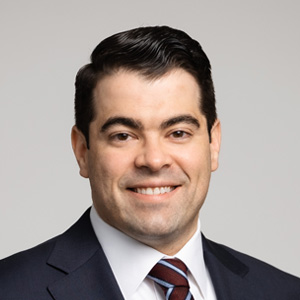
Cadwalader’s Wes Misson was recently recognized as part of the Charlotte Business Journal’s “40 Under 40” 2022 awards program, an annual series designed to acknowledge young professionals who are “making a difference in the region.” This honor reflects Wes’s outstanding work on behalf of our clients and his recent appointments as head of the U.S. Fund Finance Team and as co-chair of the Firm’s Finance Group. Congrats to Wes and all his co-honorees, who represent a diverse range of businesses and organizations across the Charlotte metro area.
Nobody does anything single-handedly, but some certainly wield a greater influence than others. It’s hard to quantify or overstate the impact that Mike Mascia has had on the Fund Finance industry – both the product itself and the individual careers of so many attorneys and bankers. Mike’s mantra/mission statement, which has become the mission statement of Cadwalader’s Fund Finance team (and why our team has become the most innovative and trusted market leader in this space), is simple: “We must have a Client-First Culture of Excellence.” That is certainly one legacy of Mike’s (along with encouragement, generosity and common-sense business advice) that will not skip a beat as our mission statement remains the same as our leadership transitions from Mike to Wes Misson, an attorney who has not only the same mantra/mission statement but also has worked with − and learned from − Mike longer than anyone.

Lots of news out of the loan market. SOFR remains a focus, we have new forms from the LSTA, and what has been deemed an “existential threat” to the syndicated loan market has reared its head once again. Here’s the rundown.

Come join WFF’s Fireside Chat with Mary Schapiro on Wednesday to learn how the financial sector is taking up arms in the battle against climate change. To register, click here.
Earlier this week, Women in Fund Finance launched its new “Reader’s Series,” which is designed to invite conversation among members of the fund finance community who are avid readers of non-fiction, with an emphasis on topics concerning both social and economic impacts. At this inaugural event, the discussion was led by Walt Jackson of Onex Credit, Mike Henry of U.S. Bank, and Cadwalader’s Leah Edelboim.

Women in Fund Finance will host a Wednesday virtual event, “Crypto 101: Demystifying Cryptocurrency & Blockchain,” featuring speaker Bob Griffin of WhiteTower Capital Management, LLC and moderated by Fazillah Durante of Scotiabank. Please visit here to register.
Join Women in Fund Finance’s first Paris event of 2022 on June 9. McDermott Will & Emery will be hosting this in-person event at the McDermott Paris office beginning at 6:30 p.m. The concert and conversation is brought to you by Zahia Ziouani, an inspiring Franco-Algerian female conductor and founder of the string quartet, “Divertimento.” Networking and cocktails will follow. To register, click here.

The Fund Finance Association has announced a virtual event titled “Collateralized Fund Obligations: The ABCs of CFOs” for Tuesday, June 14 at 12 p.m. EST. For more information or to register, click here.
Brickfield Recruitment’s latest interview features Emma Russell, FFA’s Europe Chair and Haynes & Boone partner. Emma will discuss her involvement in the evolution of the FFA, its European initiatives, and what’s in store for the FFA European Symposium on June 28 in London.

One aspect of NAV loans that lenders often focus on is the risk of “bad acts” by a borrower with respect to the investments that underpin the loans. For our purposes, NAV loans are loans to alternative investment entities (e.g., private equity funds, secondaries funds, hedge funds, funds of hedge funds, pension funds and family office vehicles) that are underwritten, either on a secured or unsecured basis, by the value of the entity’s investments. When entering into NAV loans, lenders assess the investments owned by the borrowers at closing and then continue to monitor such investments after closing for compliance with financial covenants and other loan requirements. Unlike other types of securities financings (think prime brokerage, securities lending and repo, or typical bank margin loans), where a lender or a third-party custodian on behalf of the lender holds or controls the securities on which the loans are underwritten, the underwritten assets in NAV loans are typically owned and controlled by the borrower, either directly or through one or more subsidiary holding vehicles.