






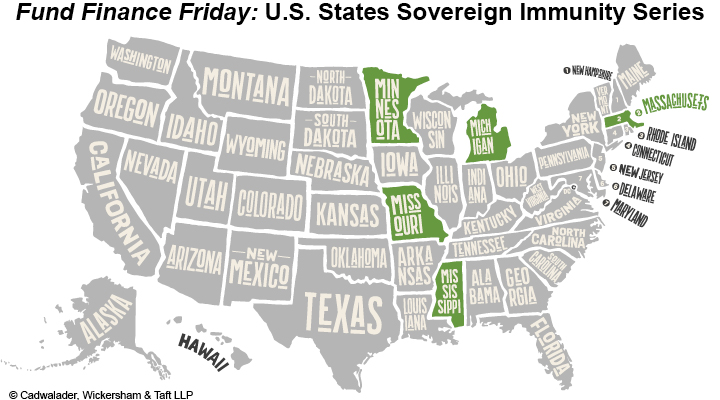
We are back today to continue along with our tasting menu of state sovereign immunity. In our fifth installment in the series, we will visit Massachusetts, Michigan, Minnesota, Mississippi and Missouri.



As the Fontainebleau once again prepares for an influx of fund finance professionals to its restaurants and nightclubs, we got to thinking about another kind of club (those funds registered with CIMA under the Private Funds Act) and what it might take for one of those funds to have the equivalent of a Dwayne “The Rock” Johnson-sized bouncer come and take them out of that club (CIMA being the relevant 300lb bouncer here!). Throughout all of the discussions from 2020 up until the present day, in relation to the Cayman Islands PF Act one of the common questions from lenders looking to analyse their risk was: “What does a de-registration of a private fund by CIMA look like and when could it happen?”




We are often asked by clients and non-Irish law firms in the context of fund finance transactions about using fund structures established under the revamped Irish Investment Limited Partnership ("ILP") regime, and, in particular, how ILPs compare to similar structures in other jurisdictions such as Lux SCSps and Cayman ELPs. We have set out a brief (and hopefully helpful) summary of these matters here.
While rising interest rates and other market data lead us to believe there will be a slowdown in fundraising, this challenging market could make opportunities in the secondary market more attractive. To cope with today's market volatility, lenders are capitalizing on smaller facilities with more flexibility to react to the different borrower profile they're seeing. Borrowers, on the other hand, are taking a more proactive approach by looking at other creative solutions, such as bespoke sub lines, hybrids and NAV lines, and even continuing step-profile fundraising to get new vehicles off the ground. Read more of what RBS believes 2023 might hold in store here.
KBRA has produced a report, “NAVigating the Resilience of NAV Loans,” that discusses the rise of NAV loans in the private equity industry, some contributing tailwinds to this recent growth, their anticipated performance amid headwinds, and KBRA’s own NAV loan exposure. The report is available here (free login required.)
Check out Private Debt Investor’s “LP Perspectives 2023 Study” for a deep dive into current investor sentiment. The annual investor survey covers topics ranging from investment strategies, allocation concerns, views on emerging managers, ESG and even the LIBOR transition.
With the Global Fund Finance Symposium in Miami less than a week away, Walkers’ Julia Keppe and Alice Wight talk to Fund Finance Association Chair Jeff Johnston about what to expect from the year's biggest event for the Fund Finance sector. Tune in here.
Partner Antoine Fortier Grethen of Lux law firm SJL Jimenez Lunz shared his insights in a new article on the Lux fund finance market in 2022, including trends and developments and the impact of recent legislative changes.
SVB is looking to hire a Fund Finance Portfolio Manager, Vice President II. For more info, visit here.

We are delighted to announce the arrival of partners Ronald Lovelace, Patrick Yingling, Jared Zajac and Joseph Polonsky, substantially enhancing the firm’s leveraged finance, private credit and special situations capabilities. The team joins from King & Spalding and will be resident in our Charlotte office.