




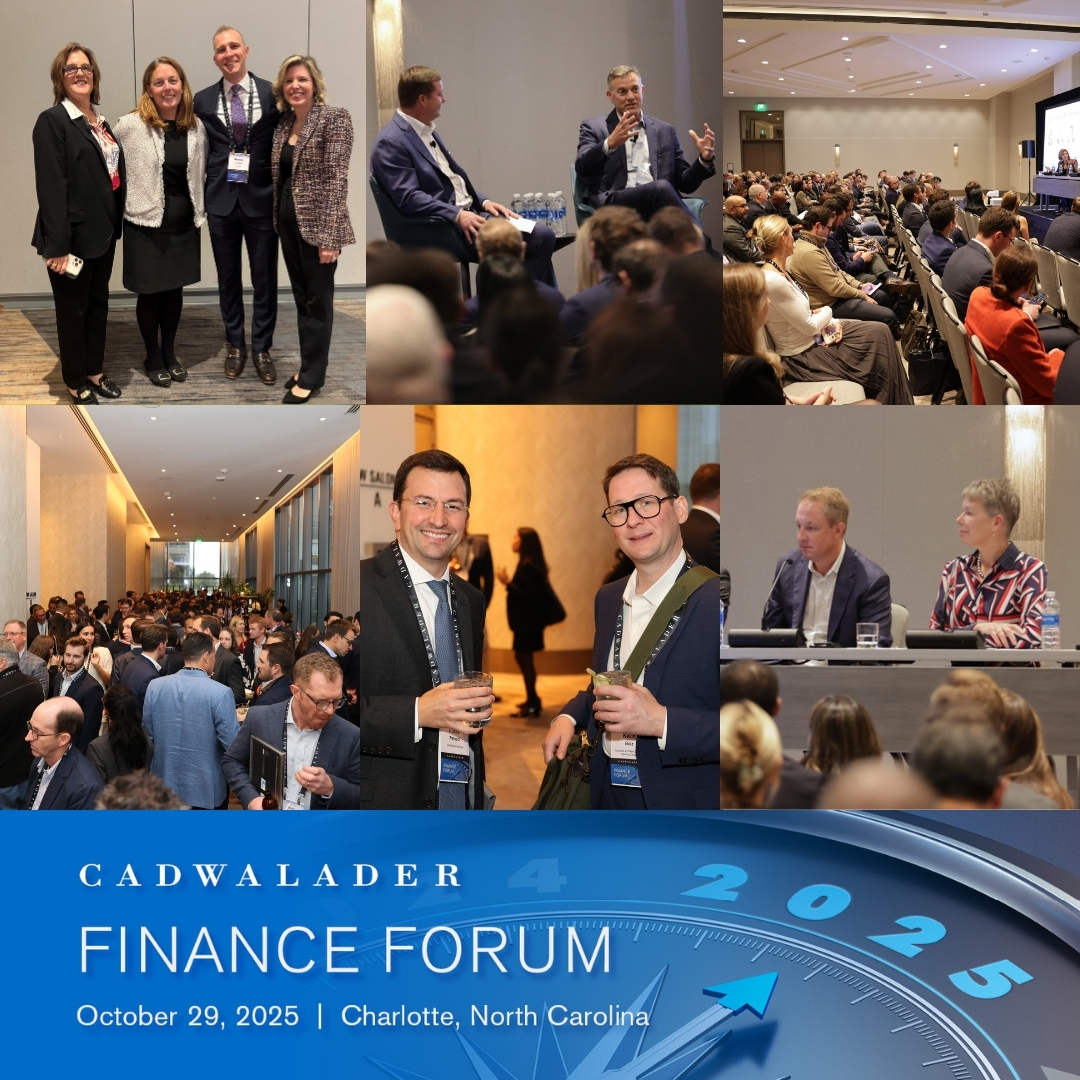
Over 800 financial industry leaders and professionals from around the country participated in Cadwalader's ninth annual Finance Forum in Charlotte this week!
It was great to meet all together for a day of networking and insightful discussions on the latest market trends and opportunities across various sectors, including commercial real estate, fund finance, leveraged finance, middle market lending, private credit, securitization and structured finance.
We are grateful to our speakers, clients and all attendees who took the time to participate in the event's many dynamic discussions and networking.
Key takeaways from some of the panels include:
Global Fund Finance Market Update 2025

Bronwen Jones and Joseph Zeidner led a panel along with Pallo Blum-Tucker, Managing Director and Head of Alternatives Lending at State Street Bank, Paul Schoper, Head of Fund Finance at Wells Fargo, and Slade Spalding, Founding Partner at NLC Capital Partners.
- The subscription market is trending toward higher advance rates and longer-life facilities.
- From a lender perspective, subscription lending continues to be marked by strong credit performance, attractive collateral, and structural deleveraging mechanics in the event of credit weakening.
- Slower fundraising has meant delays in syndications as upsizes lag farther behind initial closes. Term loans also reduce revolver participation availability at the margin.
- High net worth pools continue to become more prevalent in investor pools.
- Rapid growth in the secondaries market is contributing to NAV uptake and, with that, demand for ratings.
- In the buyout space, NAV borrowing is more commonly associated with working capital needs or acquisition financing rather than dividend recap.
Securitization Structures in Fund Finance
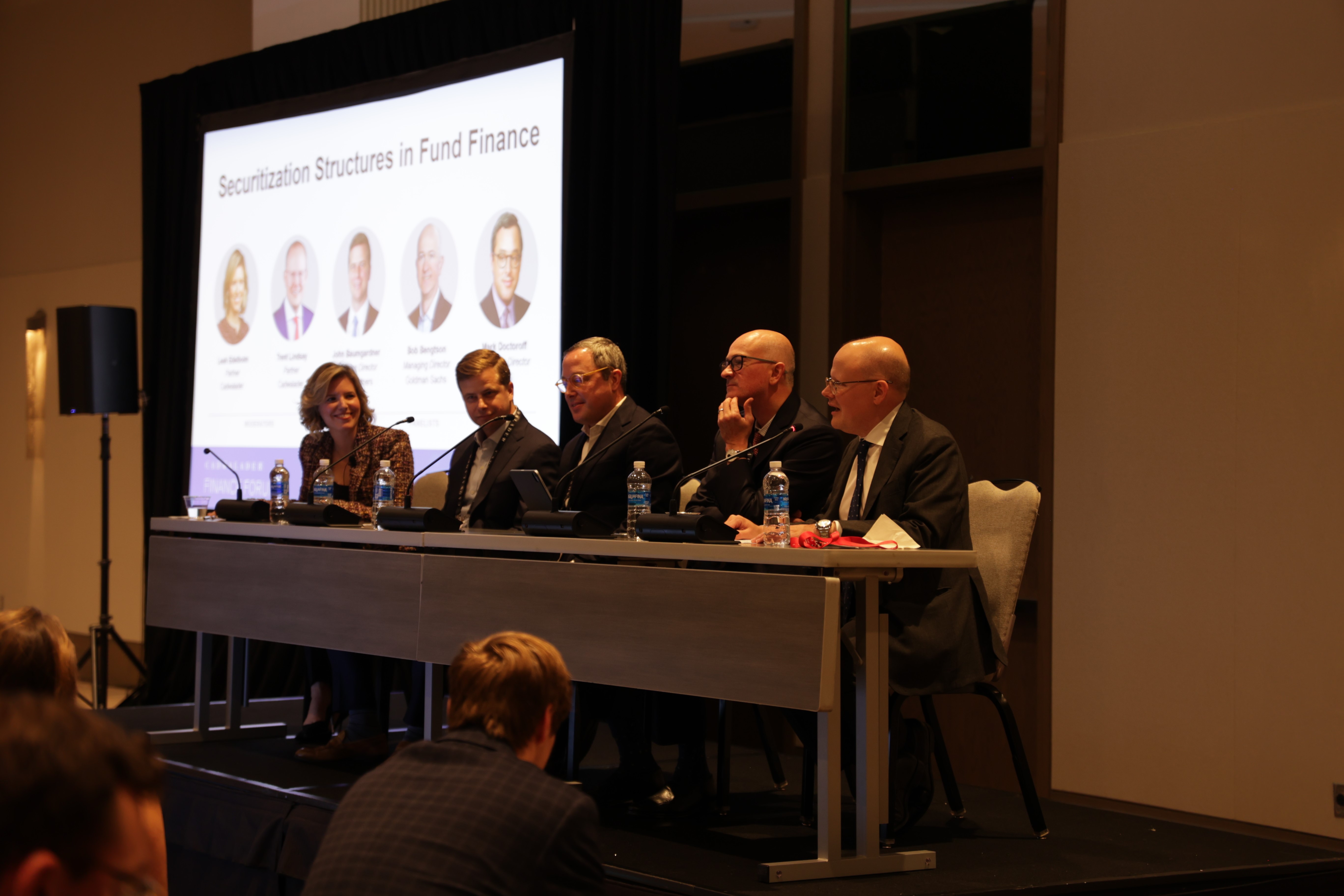
Leah Edelboim and Trent Lindsay led a panel along with John Baumgardner, Managing Director at Värde Partners, Bob Bengtson, Managing Director at Goldman Sachs, and Mark Doctoroff, Co-Head of the Financial Institutions Group and Financial Sponsors Coverage at MUFG.
- In just this year securitization structures in fund finance have proliferated to a mix of public and private transactions.
- The SRT market paved the way for securitization by demonstrating how a disclosure framework can be structured to balance borrower interest in confidentiality and adequate pool data to investors.
- Balance sheet constraints have receded as a motivation for securitization, with lenders generally now placing more emphasis on developing tools to opportunistic deploy into wider pricing windows.
- Mechanically, bringing subscription loans into the securitization market involves simultaneously solving a set of challenges, including (1) the revolving nature of the loans, (2) providing on-demand multicurrency funding, (3) preserving the institution-level sponsor relationships, (4) agreeing on a disclosure regime that works for sponsors and investors, and (5) allocating voting rights. The transactions that have come to market demonstrate that all of these can be solved.
- Forward-flow arrangements have particular synergies for lenders with captive asset managers that can play a meaningful role in pool management and distribution.
- Ultimately, subscription lenders are primarily NIM-driven. In the context of securitization, this means lender-issuers are likely to retain an interest in the loans, and provides investors with an attractive alignment of interests.
- Looking forward, panelists expected more securitizations in the next year, but also for the market to grow at a gradual pace. Over time, the short maturity profile of existing deals will contribute to refinancing-driven issuance.
Newest in NAV

Patrick Calves and Doug Murning led a panel along with Sara Casey, Director at AllianceBernstein, Christina Bohm, Managing Director at EverBank, and Dan Berglund, Managing Director at Goldman Sachs.
- The NAV financing market is poised for significant, long-term growth, fueled by the continued expansion of private market AUM and increasing fluency among market participants regarding use cases.
- NAV facilities remain a highly dynamic and customizable product, with both borrowers and lenders innovating sophisticated structures to address evolving and complex market challenges.
- NAV is seeing increased adoption by subscription line lenders through the use of hybrid facilities as well as enhanced subscription facilities that include a pledge of the proceeds of fund assets.
- While macroeconomic factors (such as a constrained exit environment and a slowdown in fundraising) have catalyzed certain uses, borrowers are increasingly integrating NAV facilities into their core strategies (e.g., secondaries financings).
- A new and attractive growth market is emerging in “lending to the lenders” via back-leverage facilities on preferred equity and other GP solutions.
- Active engagement and education by Fund Sponsors on the strategic benefits of NAV facilities are successfully increasing LP receptivity and acceptance of this financing tool within fund structures.
- Despite the extremely positive growth outlook, the market’s trajectory necessitates a continues focus on establishing best practices for risk management and appropriate structuring to ensure sustainable and disciplined expansion.
The Intersection of Rated Note Feeders and Sublines

Angela Batterson led a panel along with Ginny Chiarello, Managing Director and Portfolio Manager at Barings LLC, Leah Edelboim, Fund Finance Partner at Cadwalader, and Dennis O'Hara, Director of the Structured Credit Group at U.S. Bank.
- From an insurance investor’s perspective, a rated note feeder is a debt product that uses structure to produce equity-like returns.
- This construct doesn’t always fit neatly into a subscription lender borrowing base and lender’s run the risk of glossing over the insurance investor’s constraints.
- Insurance investors are sizeable investors and often material to the overall credit quality of the collateral pool, making it imperative for lenders to understand and work with these investors.
- For insurance companies, regulatory capital charges differ significantly between debt and equity, with equity incurring the highest capital charge. For this reason, rated note feeder structures are a capital efficient way for insurance companies to indirectly make an investment into the main fund.
- For subline lenders to give borrowing base credit to insurance company investor commitments, it’s important that such lenders have the ability to call those investor commitments (whether characterized as debt or equity) upon an event of default. However, if an insurance company’s debt commitments to a rated feeder are treated or interpreted as equity under the constituent documents (or the relevant commitment documents) of the rated note feeder, there is potential regulatory risk that these commitments could be reclassified as equity, causing insurance companies to face very significant increases in their capital charges.
- As insurance companies have become much more sizable investors in feeder structures, the NAIC has also increased its scrutiny into how insurance companies account for their investments.
- The combination of these factors has created an inflection point in this space, and interesting structuring considerations for rated note feeder and subline financings where insurance capital is involved.
Stay tuned for more in-depth coverage of this year's Finance Forum in the next Fund Finance Friday issue.