





- Our first-half performance is on pace to surpass the firm’s record 2024
- We’re achieving great results for clients and adding exceptional legal talent
- Our culture of community, innovation and inclusivity is stronger than ever
With half of 2025 already in the books, I’m pleased to take this opportunity to thank all of our clients and friends for the opportunities that our firm has had to work together with you on important projects and matters. We greatly appreciate the trust that you put in us to help pursue important opportunities and overcome important challenges.
As America celebrated its 249th birthday this month, we at Cadwalader are in our 234th year of innovating and providing best-in-class services for clients. As Wall Street’s oldest law firm, Cadwalader has successfully navigated challenges across our profession and the world throughout our history. The current environment is no exception: law firms today face unprecedented challenges and unprecedented competition for clients and talent.
At Cadwalader, we’re incredibly fortunate to have had an outstanding first half of 2025, thanks to the trust our clients place in us and the commitment to excellence our people demonstrate every day.
Here are a few highlights.
Our First-Half Performance: We’re Busier Than Ever
As reported by the press in both the U.S. and UK, Cadwalader delivered a record performance in 2024. I’m excited to share that, through the first six months of 2025, we’re pacing ahead of that record performance. We’re busier than ever because you continue to entrust us with your most pressing, sophisticated transactional, litigation and regulatory matters.
As we’ve previously shared with you in Real Estate Finance News and Views, our current Real Estate team, under Holly Chamberlain’s leadership, is achieving great results for clients. As Holly told the press earlier this year, “...everything we did yesterday, we're still doing today, tomorrow and into the future.”
They have certainly been proving it. Since the beginning of May, the team has closed over 20 deals – and they continue to bring in new matters at an incredible pace, from longtime clients and new clients alike. And, as this newsletter’s “Recent Transactions” column demonstrates every month, these are big, consequential deals.
Great Results Require Great Talent
Our optimism is fueled by investing in exceptional lawyers to help our clients achieve their goals. Cadwalader continues to be a destination for the profession’s top talent during the first half of 2025 on both sides of the Atlantic:
- In the UK, we’ve welcomed Fund Finance partners Bron Jones, Doug Murning and Matt Worth; Infrastructure Finance partner Rebecca Crowley; and, just recently, Leveraged Finance partner Ed Holmes.
- In the U.S., we proudly welcomed back two Cadwalader alumni to our partnership, including Dan Meade in Financial Regulation and Doug Mintz in Financial Restructuring.
- And we have continued to invest in our Real Estate practice: We promoted Sulie Arias to partner. We also welcomed London Special Counsel Matt Peters and, in the last few weeks, have added associates Christina Bai, Michael Capellupo, Chennell Coleman, Carter Lawson and Alexandra Levy.
Watch this space, as we plan to share more news about our growth in the months ahead.
We’re Empowering One Another and Our Communities
Supporting our people to deliver the best legal services means giving them an environment in which to grow, the tools to demonstrate agility and ingenuity, and the lessons in citizenship that define our culture and values. Some highlights since January include:
- Cadwalader was honored by the International Financial Law Review as the Career Development Law Firm of the Year at its annual awards dinner last month. This recognition reflects our robust Center for Career Advancement and our commitment to inclusivity, including the training and mentoring programs we provide our lawyers at every stage of their careers.
- We were also recognized by The American Lawyer for our 1792 Accelerator, a firm-wide innovation program driven by our lawyers. We continue to be among the profession’s leaders in using technology to increase efficiency, drive new business and develop proprietary products. Being named a finalist for the New York Legal Award for Innovation is something we’re all very proud of.
- Fighting hunger remains at the heart of Cadwalader’s long-standing tradition of serving the public good. During the first six months of the year, we led volunteer and philanthropic efforts in each of our communities, partnering with Food Bank Aid in London, Martha’s Table in Washington, D.C., A Roof Above in Charlotte, and Food Bank for New York City. Through our Justice Served campaign, which we founded 10 years ago, we mobilized more than 40 law firms and corporate legal departments to fund the delivery of 1 million meals to New Yorkers in need.
None of what I’m sharing here would be possible without our clients. Our success happens because you trust us to guide you through both great opportunities and complex challenges.
As we enter the second half of 2025, our focus remains unchanged. We understand how your needs are evolving, and we’ll continue to grow Cadwalader to meet them. As we like to say, we’re not a firm that claims to do everything – but we are among the best at everything we do. That commitment to legal excellence and client service is the promise we make to each of you, and the standard by which we hold ourselves accountable.
On behalf of our partnership and firm, thank you for your friendship, your support and the opportunities to accomplish great things together. I wish you a fantastic summer and look forward to keeping in touch.
Pat

Please join us in welcoming Michael Capellupo, Carter Lawson, Chennell Coleman, Christina Bai, Alexandra Levy and Sofia Siciliani to Cadwalader.
Michael Capellupo joins the Real Estate Finance team as an associate in New York. Michael comes to Cadwalader from a national law firm. His practice is focused on real estate finance, with key experience in mortgage finance, mezzanine finance, construction finance, real estate workouts and restructurings, joint ventures and loan sales. As a former real estate litigator, Michael is keenly situated to protect clients’ interests in negotiating loan documents as well as identifying and resolving potential issues that could negatively impact collateral.
Michael has consistently been awarded the annual Super Lawyers “Rising Stars” distinction in the field of Real Estate since 2019. Michael was also recognized in the 2025 Edition of The Best Lawyers in America: Ones to Watch for his achievements in the field of Real Estate Law.
Michael received his J.D. from Fordham University School of Law and his B.B.A. from City University of New York, Queens College.
Carter Lawson re-joins the Real Estate Finance team as an associate in Charlotte. Carter returns to Cadwalader from a boutique law firm. He focuses his practice on commercial real estate finance, primarily representing lenders in the financing of an array of asset classes, including office, retail, hotel, industrial and multi-family housing. Carter has experience with multi-state and multi-property pooled transactions in connection with the origination of mortgage and mezzanine loans as well as the servicing and sale of mortgage loans, participation interests and loan workouts.
Carter received his J.D. from William & Mary Law School, and his B.A. from Washington and Lee University.
Chennell Coleman joins the Real Estate Finance team as an associate in Charlotte. Chennell comes to Cadwalader from a global law firm where she represented financial institutions in connection with the origination of mortgage loans secured by various types of commercial properties, including, office, retail, hotels, industrial and multifamily. Chennell also has experience in the origination of mezzanine loans.
Chennell received her J.D. from University of North Carolina School of Law and her B.A. from University of North Carolina at Charlotte.
Christina Bai joins the Real Estate Finance team as an associate in New York. Christina comes to Cadwalader from a global law firm where she represented institutional lenders in connection with the origination of mortgage loans and letter of credit financing for the pre-development, construction, rehabilitation and permanent phases of multi-family and mixed-use projects.
Christina received her J.D. from Fordham University School of Law, where she was Editor-In-Chief of the Fordham Urban Law Journal and her B.A. from Smith College.
Alexandra Levy joins the Real Estate Finance team as an associate in New York. Alexandra comes to Cadwalader from a large law firm based in New Jersey where she represented a broad range of clients in commercial real estate transactions. She has experience working on transactions involving a variety of asset classes, including multifamily, office, industrial, and retail properties.
Alexandra received her J.D. from New York Law School and her B.A. from State University of New York at Albany.
Sofia Siciliani joins the Real Estate Finance team as an associate in New York. Sofia received her J.D. from Cornell Law School and her B.S. from Cornell University.
Each of these new team members brings a wealth of knowledge and unique experiences that will strengthen our ability to provide outstanding service to our clients.


In HSBC Bank USA, N.A. v. Andrea Joy Nussinow, the Supreme Court of the State of New York denied HSBC Bank’s request to reform a residential mortgage and related foreclosure that included an incorrect legal description of the property, due to the expiration of the statute of limitations.
Nussinow owned two separate parcels of land, the first containing her primary residence and the second a vacant lot. In 2005, Nussinow obtained a residential mortgage that was intended to be secured by both parcels of land. Each parcel of land had the same physical address and tax map identifier.
A foreclosure action was commenced on July 16, 2012, and a judgement of foreclosure was thereafter issued. Subsequent to the foreclosure sale, it was discovered that the legal description provided in the mortgage, Notice of Pendency and Judgement and Foreclosure and Sale omitted the metes and bounds description for the parcel of land containing the residence and only contained the metes and bounds of the vacant lot. HSBC Bank argued that the error was typographical and the mortgage and all subsequent documents should be corrected nunc pro tunc. This request constituted an application to reform the mortgage. Additionally, HSBC Bank requested that the foreclosure sale be vacated and that additional time be granted to conduct another foreclosure sale.
The Court denied HSBC Bank’s requested relief on the grounds that an action to reform a mortgage due to mistake is subject to a six-year statute of limitations, which commences at the time of the mistake. Since the mortgage was granted by Nussinow in 2005, the statute of limitations expired in 2011 prior to the commencement of the foreclosure action in 2012. While the statute of limitations for a mortgage foreclosure is six years from the date of acceleration, here the mistake constituted a request for reformation which accrued on the date the mortgage was granted.
In a recent decision in New York County Supreme Court,[1] the Court granted the plaintiff lender’s pre-summary judgment motion to appoint a receiver in a mortgage foreclosure action, even though the defendants (borrower) vehemently disputed the foreclosing lender’s standing to commence the action in the first place.
The lender commenced an action in February, 2025 to foreclose a 2017 mortgage, alleging a payment default on the underlying promissory note. Shortly after commencing the action, the lender moved ex parte for the appointment of a receiver. The mortgagor and guarantor on the loan opposed the motion.
Although New York’s Real Property Law recognizes the right of the parties to a mortgage loan to agree that, in the event of a default, a receiver may be appointed without notice to the borrower and without regard to the sufficiency of the collateral[2]—a provision regularly found in New York mortgages—the Court held that the appointment of a receiver under such circumstances is “not perfunctory” and that the Court, in its equitable power, “retains the discretion to deny the appointment of a receiver”.
Here, the Court held that the plaintiff established its entitlement to the appointment of a receiver based upon the text of the loan documents, which provided that, “[i]n any action to foreclose the Consolidated Mortgages the Mortgagee shall be entitled to the appointment of a receiver without notice, and without regard to the adequacy of the security”, and upon the fact that the defendants failed to demonstrate that denial of the appointment of a receiver in this case would be “an appropriate exercise of the Court’s discretion”.
The Court held that the defendants’ objections to the plaintiff’s standing to commence the action and the sufficiency of the affidavit submitted in support of the motion were not valid grounds for denying the appointment of a receiver. The Court stated further that a plaintiff need not demonstrate “more than what is required by Real Property Law § 254(10)” and that, ultimately, “a receiver may be appointed so long as an action has been commenced”.
Had the subject mortgage not included the language of RPL § 254(10), the plaintiff would have been relegated to rely on other statutory grounds for the appointment of a receiver which carry much more stringent prerequisites.[3]
It is notable that common defenses to foreclosure, such as standing and evidentiary sufficiency of affidavits, did not defeat the lender’s motion to appoint a receiver. Instead, this decision suggests that borrowers might fare better by requesting that the Court invoke its equitable powers in an appropriate exercise of the Court’s discretion to deny the appointment of a receiver due to the unique factual circumstances of a particular case.
[1] SIG CRE 2023 Venture LLC v. West 24-27 Realty LLC, No. 850066/2025 (N.Y. Sup. Ct., N.Y. Cnty. June 9, 2025) (Kahn, J.).
[2] See N.Y. Real Prop. § 254(10).
[3] See N.Y. C.P.L.R. § 6401 (requiring the movant to demonstrate that “there is danger that the property will be removed from the state, or lost, materially injured or destroyed”).

We're thrilled to announce the 9th Annual Cadwalader Finance Forum will take place on Wednesday, October 29, in Charlotte.
This premier event brings together industry leaders and experts for a day of networking and insightful discussions on the latest market trends and opportunities across various sectors, including commercial real estate, fund finance, leveraged finance, middle market lending, private credit, securitization and structured finance.
Stay tuned for a detailed schedule featuring fantastic speakers, substantive panels and a keynote speaker you don't want to miss. We look forward to welcoming you in October!
Register here.
For any inquiries about this event, please contact Cori Niemann.
Please note that this event is closed to press.
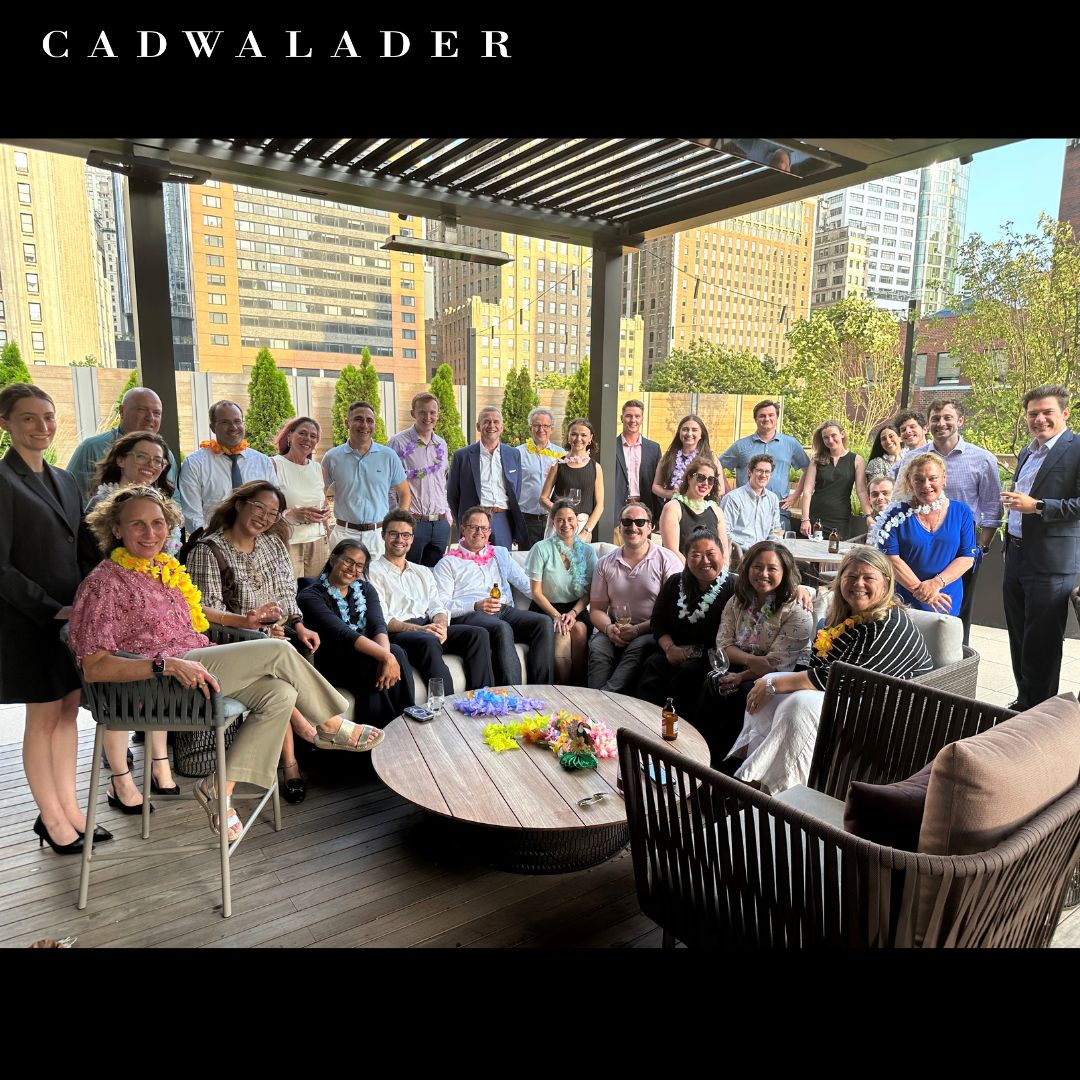
Earlier this month, the quarterly Real Estate Finance happy hour in New York was joined by the transactional summer associates to mingle with Cadwalader attorneys and learn more about the practice in an informal setting.
Head of Cadwalader's Real Estate Finance practice, Holly Chamberlain, along with partners Kevin Sholette and Chris Dickson, visited from the Charlotte office.
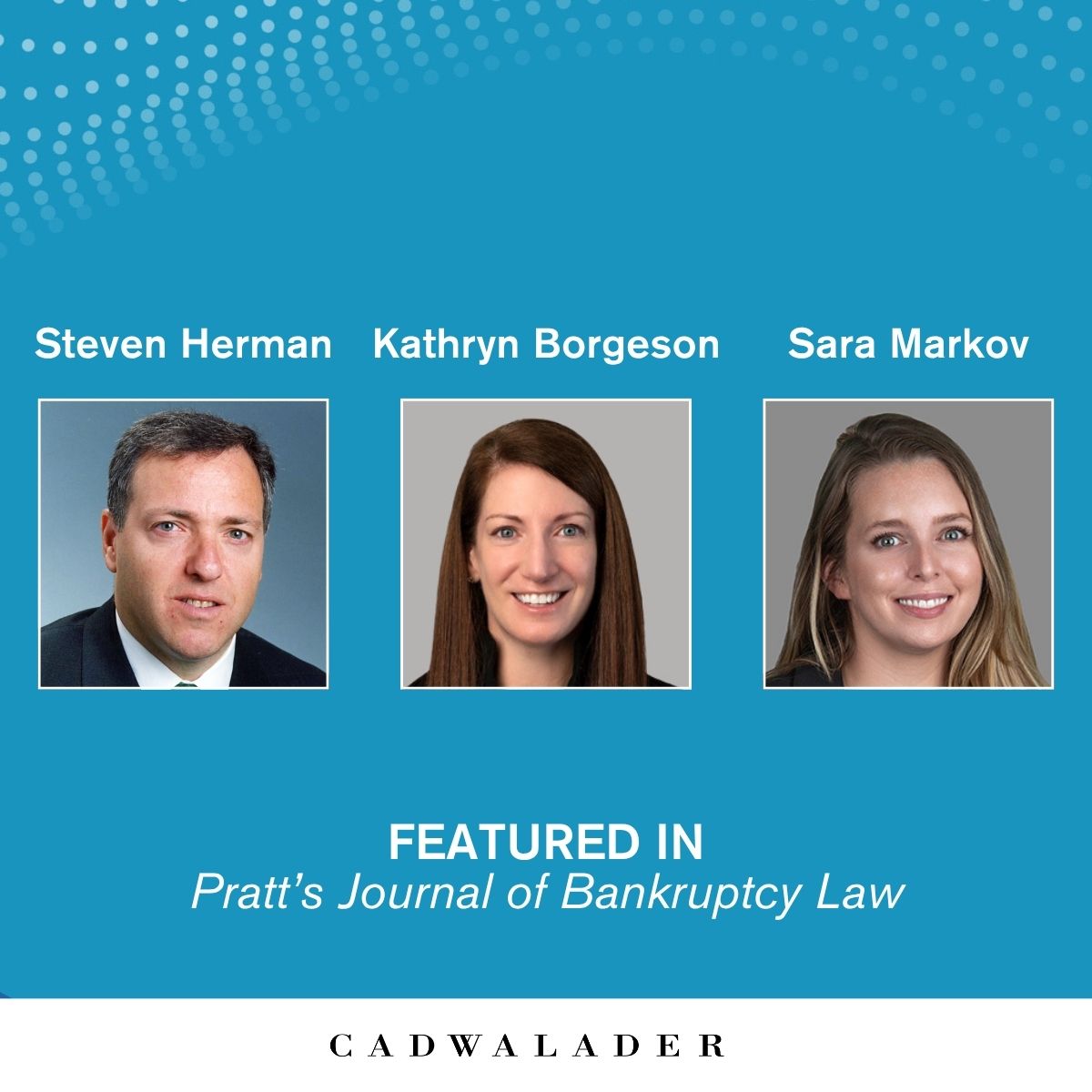
Cadwalader attorneys Steve Herman, Kathryn Borgeson and Sara Markov authored an article, “The Impact of In re 301 W N. Ave., LLC, on the Enforcement of Bankruptcy-Remote Protections,” published in the July-August 2025 edition of Pratt’s Journal of Bankruptcy Law.
In the article, the authors analyze a recent bankruptcy court decision in In re 301 W N. Ave., LLC, where the court upheld “the enforceability of provisions requiring an independent manager’s consent prior to a borrower filing for bankruptcy.”
The ruling “represents a significant development at the intersection of corporate governance, commercial real estate, and bankruptcy law and reinforces the role of structured corporate governance mechanisms in protecting lenders from undesired bankruptcy filings.”
Published eight times a year, Pratt’s Journal of Bankruptcy Law “features analysis, practical guidance, and commentary exploring bankruptcy legal developments and decisions.” Learn more here (subscription required).

Cadwalader partner and head of the firm’s Real Estate Finance practice, Holly Chamberlain, has been recognized in Forbes’ 2025 America’s Best-In-State Lawyers guide for her work in Real Estate Law in Charlotte, North Carolina.
The guide highlights top lawyers across all 50 states who have demonstrated excellence and earned the trust of clients, colleagues and the broader legal community. Forbes selected honorees through a rigorous, multi-stage process of researching, evaluating and rating thousands of candidates.
Read more about the guide and the full list of honorees here.

Cadwalader practices have once again been recognized among the nation’s best in the 2025 edition of The Legal 500 United States.
Among the rankings, the firm’s Real Estate Finance practice earned national recognition, with Holly Chamberlain named a Leading Lawyer, reinforcing Cadwalader’s strength in complex real estate transactions.
View Cadwalader’s rankings on The Legal 500 website.

Cadwalader partner Sulie Arias was recently named to the 2025 edition of Lawdragon 500 X – The Next Generation. The list recognizes lawyers with fewer than 15 years out of law school who are already making a significant mark in their practices and shaping the future of the legal profession.
Sulie was recognized in the Real Estate category in New York.
Lawdragon describes its 2025 class as “mesmerizing, multi-talented, dedicated, focused – and the best argument there is for the vitality of the law.”
Read the full list here.

Here is a look at what we’re reading:
The CRE CLO Comeback Story: Market Trends & Execution Strategies with Steve Chow, Prime Finance
In this episode of The TreppWire Podcast, hosts are joined by Steve Chow, Principal and Head of Capital Markets, Analytics and Trading at Prime Finance. Steve oversees the firm’s financing and capital markets activity across three distinct commercial real estate debt strategies, including their bridge lending platform that has issued 12 CRE CLOs over the past decade. They dive into the current CRE CLO market resurgence, exploring why issuance has more than doubled in 2025, the relative value proposition driving crossover investors into the space and the lessons learned from executing deals through various market cycles. They also discuss multifamily market fundamentals, investor concerns around deal structuring and Prime Finance’s approach to transparency and portfolio diversification.
Read more here.
The Let Them Theory by Mel Robbins
If you’re feeling burned out trying to manage other people’s reactions or expectations—this one’s for you. In “The Let Them Theory,” Mel Robbins delivers a simple idea: when people act a certain way—flake out, criticize, undervalue you—just let them. That’s it. It sounds too simple to matter, but it hits hard—especially for lawyers who are constantly managing clients, colleagues, opposing counsel, and everything in between. This book is like a breath of fresh air for anyone who’s ever been stuck in people-pleasing or overthinking mode (so… most of us).
Read more here.
Recent transactional highlights include Cadwalader representing:
- Wells Fargo Bank in the $350 million mortgage and mezzanine financing of a 29-property industrial and office portfolio totaling approximately 4.2 million square feet across seven states, owned by Agellan Commercial REIT Holdings Inc. The deal included a mortgage loan slated for SASB securitization and the origination and sale of a $50 million mezzanine loan.
- Lender in the $241,700,000 refinancing of a five-building, 521-unit multifamily complex located in Los Angeles, California.