






In a recent foreclosure action, Plaintiff Lakeview Loan Servicing, LLC (“Lakeview”) sought summary judgment against Defendant Andrew Branley (“Branley”). Lakeview claimed that Branley executed a Note to JPMorgan Chase Bank, N.A. (“Chase”) on June 12, 2013, in the principal amount of $317,091.00, secured by a mortgage and a Consolidation, Extension and Modification Agreement (“CEMA”) of the same date. The mortgage and CEMA were recorded in August 2013. Lakeview asserted that the Note was endorsed in blank, transferred to Lakeview and that an Assignment of Mortgage from Chase, dated February 6, 2019, was recorded shortly thereafter. Lakeview maintained it had physical possession of the original Note prior to commencing the action in June, 2023 and that Branley had been in default since April 1, 2020.
Branley opposed, arguing that Lakeview failed to prove it held the Note at commencement of the foreclosure action. He challenged the affidavit from Lakeview’s servicer, Flagstar Bank, for not confirming review of Lakeview’s own records, for omitting any statement that the original Note was examined and for lacking supporting business records. He also disputed the amount owed, claiming he borrowed only $6,001.67 under the CEMA and asserted that the 2019 Assignment of Mortgage referenced only the original 2010 mortgage, not the Consolidated Mortgage or Consolidated Note, raising questions about Lakeview’s ownership.
Lakeview responded by producing the Consolidated Note, endorsed in blank and the CEMA, contending that possession of the Note was sufficient to establish standing. It argued that Branley’s debt was consolidated into the $317,091.00 obligation, that all rights were merged into a single lien and that Branley had not submitted admissible evidence to create a factual dispute.
The Court agreed that Lakeview demonstrated the existence of the mortgage, unpaid Note, default and standing, satisfying its initial burden. Branley’s argument that Chase lacked ownership at the time of the CEMA was rejected; the Court found that MERS, Inc. had assigned the Mortgage to Chase prior to the CEMA and that the unrecorded Assignment was referenced in the agreement.
However, the Court identified a critical factual dispute: the February 6, 2019 Assignment of Mortgage from Chase to Lakeview appeared to transfer only the original 2010 mortgage, which had been merged into the Consolidated Mortgage and did not expressly reference the Consolidated Mortgage or Consolidated Note. This uncertainty as to whether the operative mortgage was assigned precluded summary judgment.
The Court denied Lakeview’s motion for summary judgment. This case highlights the importance of ensuring that Assignments of Mortgage clearly encompass the operative Consolidated Mortgage and Note in foreclosure proceedings.
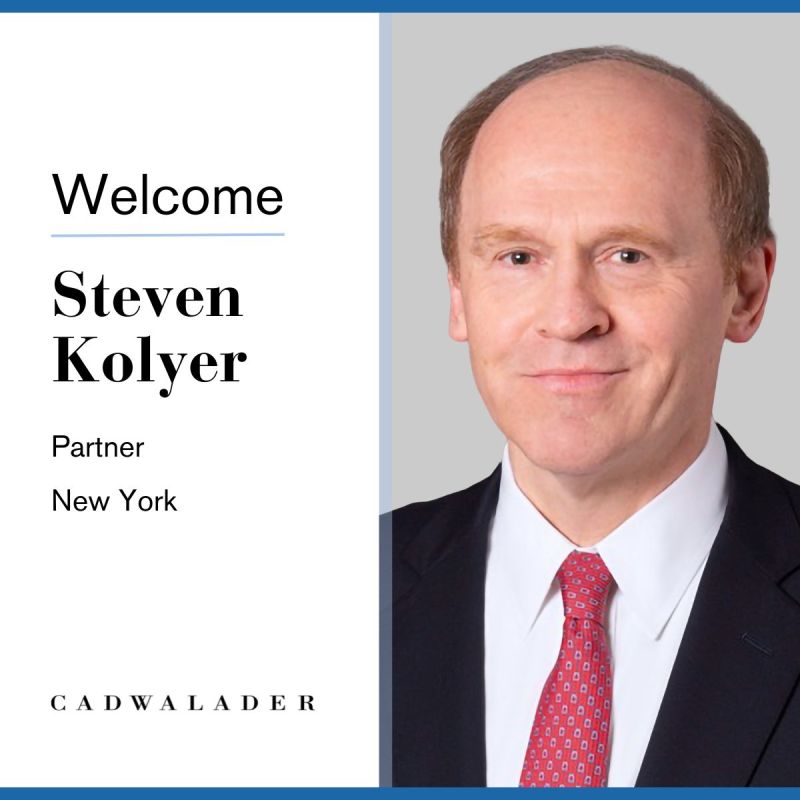
Steven T. Kolyer, a leading securitization and structured products lawyer specializing in commercial real estate finance, has joined Cadwalader as co-head of the firm’s CRE CLO practice, based in New York. Steven will co-head the practice with Jeffrey Rotblat, a senior Cadwalader partner who is also a leader in commercial real estate securitization.
“We are very excited to welcome Steve to our firm,” said Cadwalader Managing Partner Pat Quinn. “Like many of our partners, Steve has played a leading role in the development of many securitization products dating back to the origins of the market in the U.S. and abroad. It’s not every day that a ‘hall of fame’ partner joins an industry-leading practice. This is great for our Capital Markets and Real Estate teams and, ultimately, an unbeatable combination for Cadwalader’s clients.”
Steven has broad experience in securitizations, structured credit products, fund formation and finance, and both real estate and corporate CLOs. He has extensive experience in a variety of structured products and financings, fund formation and finance, and conventional securities offerings, including asset-based securities and a broad range of other fixed income debt products. Steven has represented various banks and funds in CRE CLOs and single asset/single borrower (SASB) CMBS issuances, as well as corporate CLOs, CFOs, investment funds and fund financings.
Steven’s innovations have included first-time structures with CRE and residential mortgages, commercial and consumer receivables and other types of financial assets, and in various types of CRE and corporate CLOs, CFOs and other actively managed fund and specialty finance products. He has been recognized as a leading securitization lawyer by numerous industry sources, including The Legal 500 U.S. (“Hall of Fame” inductee and “Leading Lawyer” in structured finance), Chambers USA (Nationwide, 2006–2025) and Chambers Global (USA, 2007–2025) (Band 1 for Capital Markets: Securitization: CRE CLOs and a “Spotlight Lawyer” for Capital Markets: Securitization – CLOs and CRE CLOs), and many other legal and business publications.
Steven, who comes to Cadwalader from a global law firm where he was a partner in its global finance department, is the latest lateral partner to join the firm in 2025 in areas of strategic importance to clients, following Bron Jones, Doug Murning and Matt Worth (Fund Finance); Dan Meade (Financial Regulation); Doug Mintz (Financial Restructuring and Special Situations); Rebecca Crowley (Infrastructure Finance); and Ed Holmes (Leveraged Finance).
The news of Steven’s arrival also comes on the heels of Cadwalader’s reported first-half 2025 financial performance pacing ahead of the firm’s record revenue results in 2024, as well as an extraordinarily busy time for Cadwalader in two key areas: securitizations, where the firm topped the first-half 2025 league tables, a position it’s occupied for over 25 years; and real estate finance, where the firm has added a number of lawyers since May 2025 and has closed over 20 major deals during the same period. As one of the most active practitioners at the intersection of securitizations and real estate, Steven’s arrival reflects a continued commitment to providing clients with integrated real estate loan origination and related securitization services.
“I am thrilled to join Cadwalader,” said Steven. “The securitization bar is a closely knit community, and there’s no greater group of hard-working, client-first lawyers than my new colleagues. We have inspired each other for decades, innovating on behalf of clients, and I can’t wait to join them in continuing this tradition of legal excellence together on the same team.”

Cadwalader Capital Markets Co-Chairs Michael Gambro and Stuart Goldstein spoke with Commercial Mortgage Alert about the firm’s quarter-century run atop the U.S. commercial mortgage securitizations rankings continuing through the first half of 2025, published today.
The article, “Cadwalader Tops CMBS Counsel Race,” noted that “Cadwalader maintained a commanding lead in the CMBS issuer counsel race during the first half, while its competitors saw little movement in the ranking from a year ago.”
Noting that the quickening pace of CMBS and CRE CLO issuances hasn't made an impact on league tables, “...Cadwalader, which has led the issuer counsel ranking every year since 2000, once again came out on top. It worked on nearly half of the CMBS offerings that priced in the first six months of the year, with 38 deals totaling $26.34 billion, according to Commercial Mortgage Alert’s CMBS Database.”
Given Cadwalader’s pace of activity, the publication noted the firm has been continuing to hire “so that we do not turn away work,” said Mike. “We don’t see much end in sight right now.”
The “real estate origination team has been firing on all cylinders,” said Holly Chamberlain, who heads the Real Estate Finance practice.
Stu, who shared his views on a hot market, told Commercial Mortgage Alert he believes there will be a shift toward private credit that will drive more demand for CRE CLO issuance. “CRE CLO and back leverage will be increasingly important to fuel the growth of bridge lending and private debt funds,” he said, adding that Cadwalader has a “deep bench” in these areas.
Read the league table article here (subscription required).

We're thrilled to announce the 9th Annual Cadwalader Finance Forum will take place on Wednesday, October 29, in Charlotte.
This premier event brings together industry leaders and experts for a day of networking and insightful discussions on the latest market trends and opportunities across various sectors, including commercial real estate, fund finance, leveraged finance, middle market lending, private credit, securitization and structured finance.
Stay tuned for a detailed schedule featuring fantastic speakers, substantive panels and a keynote speaker you don't want to miss. We look forward to welcoming you in October!
Register here.
For any inquiries about this event, please contact Cori Niemann.
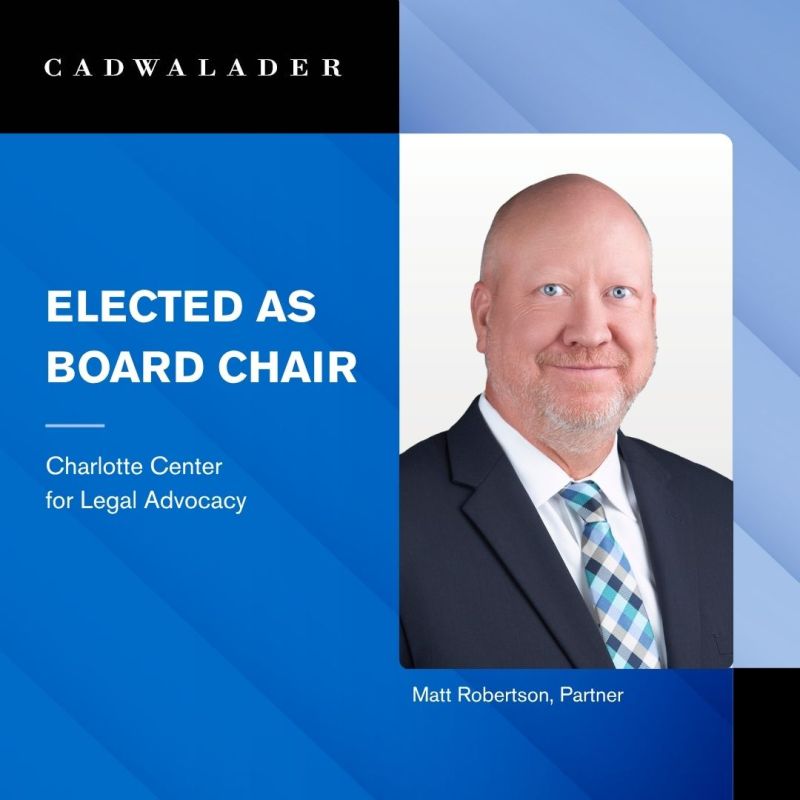
Cadwalader Real Estate partner Matthew Robertson was recently elected as Board Chair of the Charlotte Center for Legal Advocacy. This honor, which comes after five years of service on the board, reflects Matt’s leadership and commitment to advancing equal access to justice. Cadwalader is proud to deepen our longstanding relationship with this incredible organization.
"By helping to ensure access to justice for everyone, the Advocacy Center fills an important role in our community," Matt told the Center. "I am stepping into this role at a time when the Center’s public funding sources are under unprecedented attack but look forward to working with new CEO Larissa Mañón Mervin as we face this challenge and continue to serve our clients."
Cadwalader has been recognized in the 2026 edition of The Best Lawyers in America, with over 40 lawyers across more than 20 practice areas featured in the guide. In addition, over 50 of the firm's lawyers have been named to the guide's edition of Best Lawyers: Ones to Watch in America list.
The following attorneys are recognized as leaders in their fields:
Charlotte, NC
- Holly Chamberlain – Real Estate Law
- Matthew Robertson – Real Estate Law
New York, NY
- Fredric Altschuler – Litigation - Real Estate, Real Estate Law
- Justin Arborn – Litigation – Real Estate
- Steven Herman – Real Estate Law
The following attorneys are recognized as "Ones to Watch" in their fields:
Charlotte, NC
- Eunji Jo – Real Estate Law
New York, NY
- Justin Arborn - Commercial Litigation, Criminal Defense: White-Collar, Litigation - Antitrust and Litigation - Real Estate
To view The Best Lawyers in America 2026 edition results, please visit here.
Eight Cadwalader lawyers have been named to the 2025 Lawdragon 500 Leading Real Estate Lawyers guide.
The second edition of this guide recognizes lawyers who specialize in a vast range of skills— development, finance, leasing, litigation, REIT structuring— on a variety of properties that can range from tricky environmental site outside San Diego to a megadevelopment for an energy company in the Middle East to a troubled Manhattan skyscraper converting from commercial to residential.
This year’s Cadwalader honorees (in the publication’s categories) are:
- Holly Chamberlain – Real Estate Finance (Charlotte)
- Christopher Dickson – Commercial Real Estate Finance (Charlotte)
- Matthew Duncan – Real Estate, Capital Markets, Socially Responsible Housing (London)
- Steven Herman – Real Estate Finance, Development, Joint Ventures (New York)
- Steven Kolyer – Real Estate, Collateralized Loan Obligations (New York)
- Alan Lawrence – Real Estate Finance, Restructuring (New York)
- Matthew Robertson – Real Estate Finance (Charlotte)
- Kevin Sholette – Real Estate Finance, Securitization (Charlotte)
Read the full list here.

Here is who’s on the move in the real estate finance industry:
.jpg)
Congratulations to Steven Caldwell on his new role as Managing Director, Head of Large Loan CMBS within Real Estate Securitization and Capital Markets at Wells Fargo. Steve brings over 20 years of real estate finance experience to the platform and his leadership and market expertise will be an asset to clients and the commercial real estate industry at large.

Here is who's hiring in real estate finance:
JPMorganChase is seeking a Credit Risk Vice President on the Real Estate Banking team in New York, New York. The VP will be responsible for a portfolio of clients and will have primary day-to-day responsibility for managing and monitoring credit exposure to them. They will work with a client base of leading real estate development and service companies. The portfolio of credit products the team manages and monitors include real estate asset level financings for ground up construction, bridge facilities and stabilized term loans, entity level working capital lines of credit, derivatives and treasury lines. Learn more here.
Recent transactional highlights include Cadwalader representing:
- Lenders in connection with a $2.75 billion refinancing transaction of a 129-property industrial portfolio. The portfolio consists of industrial properties spanning 12 states, including California, Florida, Georgia, Maryland, Minnesota, North Carolina, New Jersey, New York, Texas, Utah, Virginia and Washington. The transaction consisted of three loans: one balance sheet loan and one bridge loan, both of which refinanced existing indebtedness secured by the portfolio and one CMBS loan
- Lenders in the $1.3 billion refinancing of One Five One, a LEED Gold Certified Class A office tower owned by The Durst Organization and located at 151 West 42nd Street, New York, New York
- Lenders in the $900 million refinancing of 1301 Avenue of the Americas, New York, New York, which is owned by the Paramount Group and is a LEED Gold Certified Class A office building
- A lender in a repo financing of a $500,000,000 loan for a portfolio of office properties located in New York state
- A lender in a repo financing of mortgage and mezzanine loans in excess of $500,000,000 for a property located in New York, New York
- A lender in the $57 million refinancing of a retail center located in San Juan Capistrano, California
- A leading investment bank in connection with two back-leverage credit facilities made to one of the world’s largest alternative asset managers. The back leverage facilities were secured by large pre-development loans to a leading data center developer and operator, which were in turn secured by applicable development sites. This is just one of a growing number of back-leverage transactions Cadwalader has worked on where the real estate finance team has worked collaboratively with corporate and commercial finance teams, among other practice groups, on complex and bespoke transactions
- A lender in the workout, modification and disposition of a distressed mortgage loan secured by a multi-family property in Florida