





The New York Court of Appeals’ (the “Court”) decision In the Matter of The Coalition for Fairness in Soho and Noho, Inc., et al., Respondents, v. City of New York, et al., keeps New York’s (the “City”) land use regime from being swept into the expanding pull of Koontz, Sheetz and the modern unconstitutional conditions doctrine. The case concerns a $100 per square foot Arts Fund fee imposed as a precondition to converting Joint Living Work Quarters for Artists (“JLWQA”) into unrestricted residential units (an optional pathway created by the City’s 2021 rezoning of SoHo and NoHo). Petitioners argued that the fee was a monetary exaction subject to Nollan/Dolan scrutiny. The Court rejected that framing at the outset, holding that the petitioners, “do not have a compensable property interest within the meaning of the Takings Clause,” and that the fee therefore, “does not constitute a taking.” The opinion evinces the Courts desire to prevent the Takings Clause from overriding routine zoning mechanisms.
The JLWQA designation, which was created in 1971 to legalize artist live/work occupancy in industrial lofts, “runs with the property” and restricts residential use to certified artists. Over the years, the neighborhoods transformed into some of the most expensive real estate in the city and non artists increasingly occupied JLWQA units. The City granted limited amnesties in 1986 and again in 2022, but the underlying designation remained intact. By 2022, nearly all JLWQA units were occupied by non conforming residents and artist certification had dwindled to a handful of approvals per year. Against this backdrop, the City adopted a rezoning plan that preserved existing JLWQA designations but created an optional pathway for owners to convert their units to unrestricted residential use by paying a one time fee, equal to $100.00 per square foot of floor space to be converted, into an Arts Fund administered by the Department of Cultural Affairs. Conversion is voluntary and owners may continue to occupy their units under existing JLWQA rules without paying the fee.
Petitioners challenged the fee as an unconstitutional condition and an uncompensated taking. The New York Supreme Court dismissed the petition; the New York Appellate Division reversed, holding that the fee was a permit condition subject to Nollan/Dolan and that it failed both the, “essential nexus” and, “rough proportionality” prongs. The Court of Appeals reversed, but not on the basis of a nexus or proportionality analysis. Instead, the majority resolved the case at the predicate stage, concluding that petitioners had not identified any property interest that the Takings Clause protects. The opinion emphasizes that the protected interest is the restricted JLWQA unit itself, not the opportunity to exchange that restricted interest for a more valuable one. As the Court explained, “the newly granted opportunity to transform the essential nature of a restricted JLWQA unit into a different, unrestricted interest is not in itself a property interest.” Petitioners, “knowingly assumed” a restricted property interest and seeking to replace that interest with a fundamentally different one does not create a constitutional entitlement to do so without conditions.
The majority’s analysis of Koontz is similarly narrow. The Court rejected the argument that any monetary condition attached to a land use permit automatically triggers Nollan/Dolan scrutiny, reading Koontz as limited to monetary demands offered, “in lieu of” a property interest that would otherwise constitute a per se taking. The fee here, the Court reasoned, is a standalone monetary charge tied to an optional regulatory benefit, not a substitute for an easement or other property interest. The City could not, “take” anything through eminent domain to enable conversion; thus, the fee does not implicate the core concerns of Nollan/Dolan. The opinion’s emphasis on this point echoes the broader judicial hesitation to treat every land use related fee as a potential exaction. Relying on Justice Sotomayor’s concurrence in Sheetz, the Court underscored that Nollan/Dolan applies only if the condition would be a compensable taking outside the permitting context. Because the fee would not be, heightened scrutiny is unnecessary.
Judge Halligan concurred in the result but rejected the majority’s reasoning that petitioners lack a compensable property interest. In her view, the fee survives only because it is not the type of monetary exaction covered by Koontz and any constitutional challenge to the fee would lie in due process, not takings. Her concurrence reflects a narrower reading of Koontz that avoids sweeping ordinary permit fees into Nollan/Dolan scrutiny. She also acknowledged that the dissent’s reading of Koontz, “has some merit, and it may well eventually prevail,” signaling that the doctrinal debate is far from settled.
Judge Garcia’s dissent, by contrast, reads Koontz broadly and treats the Arts Fund fee as a textbook monetary exaction. In his view, the fee is, “a monetary exaction demanded from a real property owner, linked to a specific, identifiable property interest, in exchange for a governmental benefit tied to their property,” and therefore squarely within Koontz. He emphasized that Koontz applies to monetary conditions regardless of whether they substitute for a physical taking and that Sheetz confirms that legislatively imposed conditions are not exempt from Nollan/Dolan. The dissent underscored that the City identified no harm caused by conversion and no evidence that the fee mitigates any impact on artists. In his view, the fee fails both Nollan’s nexus requirement and Dolan’s proportionality requirement. The dissent’s framing, particularly its emphasis on the absence of any demonstrated harm to the artist community, tracks the way exactions litigators have been positioning similar cases as vehicles for clarifying the scope of monetary exactions after Koontz and Sheetz.
The decision provides meaningful guidance for municipalities structuring conversion or legalization programs. Optional pathways that allow owners to exchange a restricted property interest for a more valuable one, accompanied by a fee, are unlikely to be treated as takings so long as the underlying restricted estate remains intact, conversion is voluntary and the fee does not function as a substitute for a property transfer. The Court’s distinction between standalone monetary fees and monetary exactions that substitute for property interests reinforces that Nollan/Dolan remains a targeted doctrine, not a general constraint on land use fees. At the same time, the dissent’s broad reading of Koontz and its insistence that the fee is an, “extortionate demand” prohibited by the unconstitutional conditions doctrine, signals continued litigation risk where fees are tied to land use approvals. The Court’s opinion narrows the circumstances under which monetary conditions trigger heightened scrutiny, but the debate over the scope of monetary exactions is far from settled and the case fits comfortably within the set of disputes that observers view as potential vehicles for further clarification.
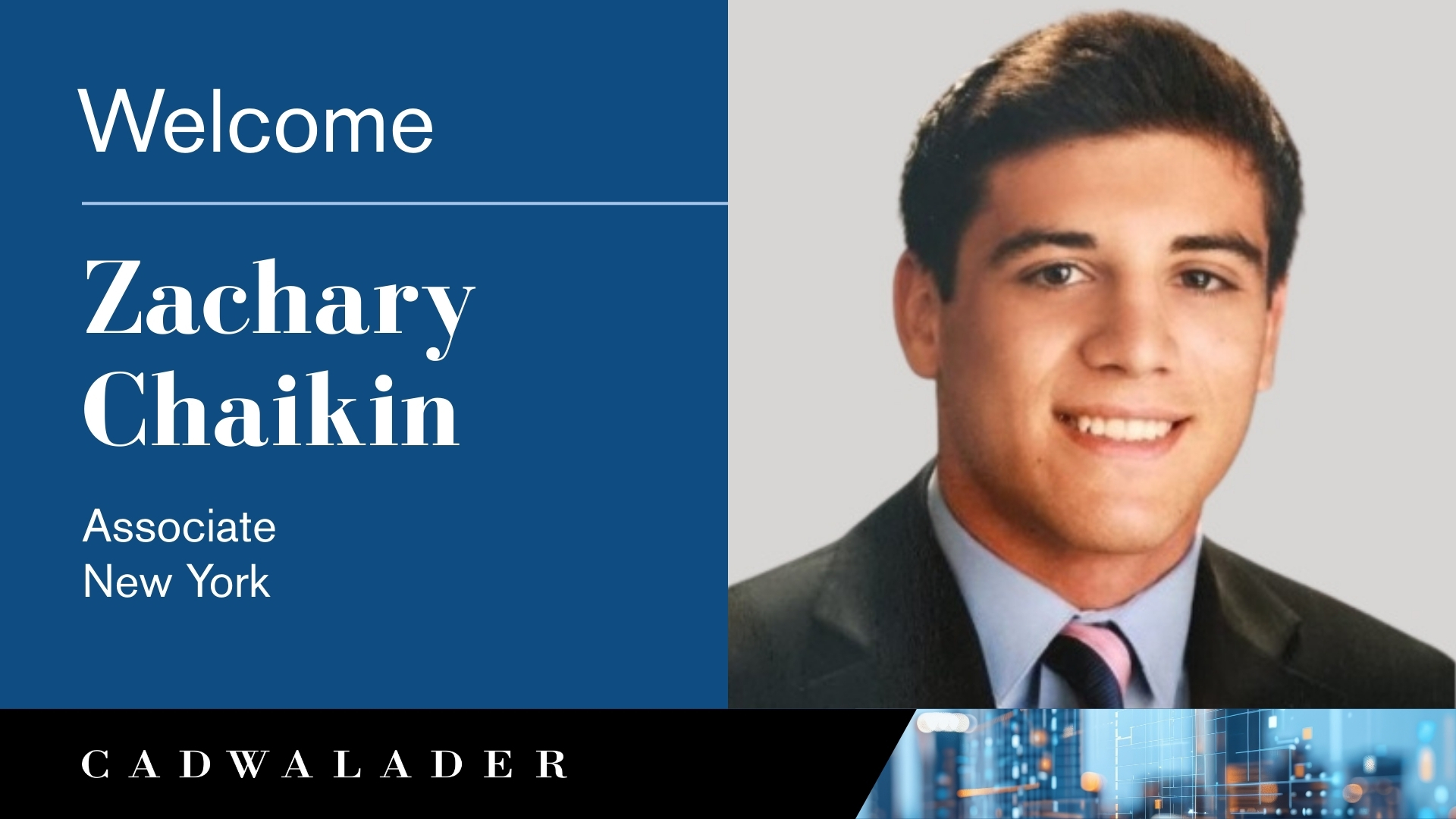
Please join us in welcoming Zach Chaikin to Cadwalader!
Zach Chaikin joins the Real Estate Finance team as an associate in New York. Zach comes to Cadwalader from a boutique real estate law firm based in New York where he represented a broad range of clients in commercial real estate transactions. He has experience working on transactions involving a variety of asset classes, including multifamily, office, industrial, and retail properties.
Zach received his J.D. from the Benjamin N. Cardozo School of Law and his B.B.A. from the University of Wisconsin-Madison.
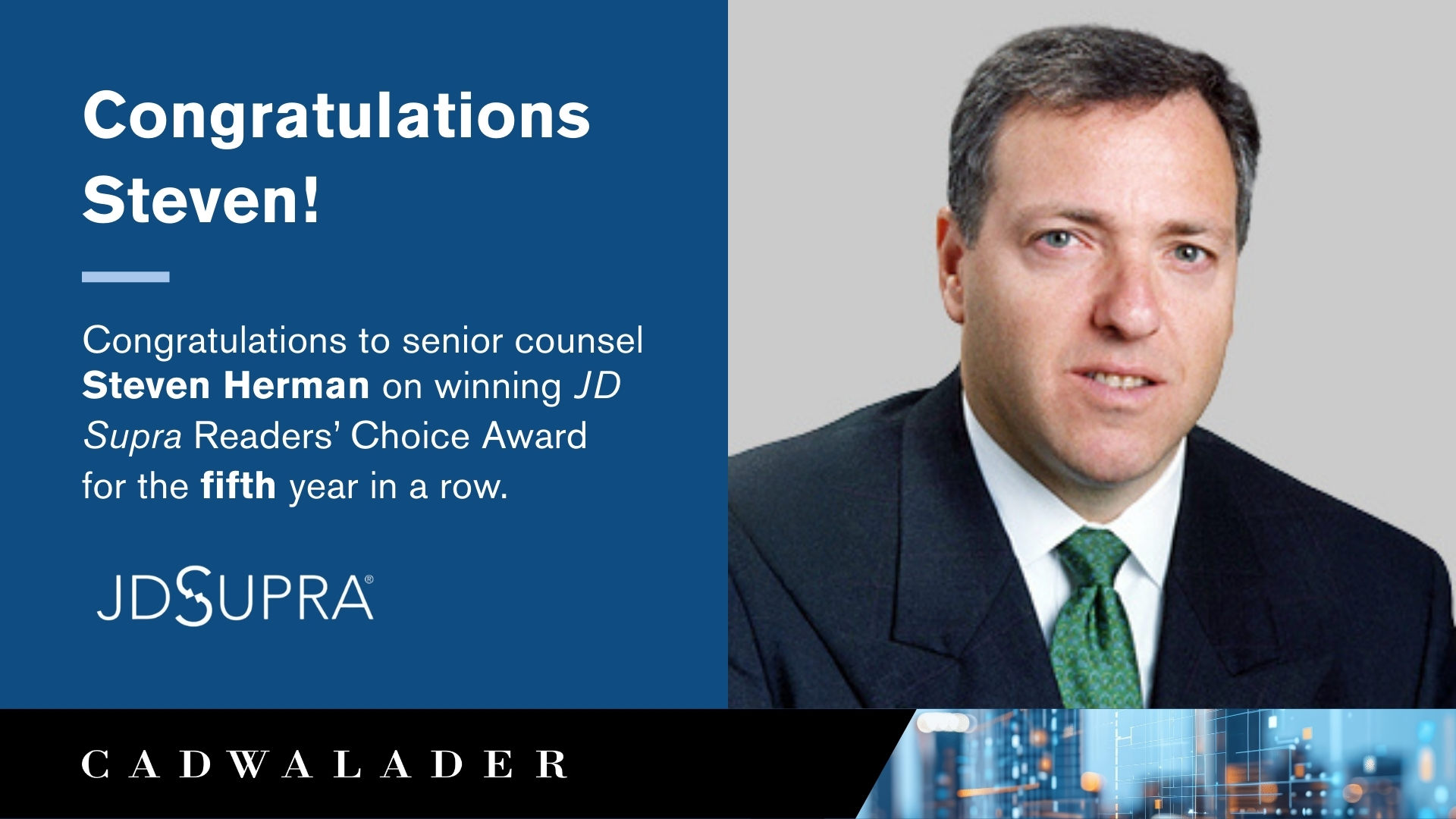
For the fifth year in a row, Cadwalader senior counsel Steven Herman was recognized with a 2026 Readers’ Choice Award as selected by JD Supra, a daily provider of legal intelligence to more than a half-million readers.
Steven won a Top Author award in the Real Estate category. According to their official announcement, JD Supra highlighted 342 authors selected from over 70,000 contributors for "the visibility and engagement” their thought leadership earned among readers in 2025.
Steven's premier thought leadership content also regularly appears in Cadwalader's Real Estate Finance News and Views newsletter.
Read the full list of award winners here.
Noting that “Cadwalader has won the title every year since 2000,” the Commercial Mortgage Alert has reported that the firm finished first as CMBS issuer counsel for the 26th consecutive year in an article, “Cadwalader Again Tops Issuer Counsel.”
In its 2025 league table coverage, the publication stated that Cadwalader “extended its lead as the most active CMBS issuer counsel last year, snuffing speculation that it would lose ground because of partner defections in its real estate finance practice.” The article goes on to note that as “nonagency issuance surged to 173 transactions totaling $125.78 billion, Cadwalader won league-table credit for 88 deals, up from 70 in 2024 ...Its deal count was twice that of second-place finisher Sidley Austin.”
Noting that “Cadwalader has continued to benefit from the depth of its practice ... [i]n December, it agreed to merge with global law firm Hogan Lovells,” Commercial Mortgage Alert offered insights from Capital Markets practice co-chair Stuart Goldstein. ““When the market heats up, [clients] want to get deals done – and often at the same time,” said Stuart, who the publication noted co-heads the Capital Markets team with Mike Gambro. “We’ve consistently invested in our depth of talent to ensure clients go to market with the same high-quality service.”
The publication went on to report that “a reawakening of the CRE CLO sector also has added rivalries. Steve Kolyer, who previously led Sidley’s CRE CLO practice, jumped to Cadwalader last year,” noting that Cadwalader topped the CRE CLO underwriter counsel league table.
Cadwalader was also listed as finishing second as underwriter counsel for CMBS, third for CRE CLO issuer counsel, and second for both the issuer and underwriter counsel categories for agency CMBS for 2025.
Read more here.
Here is who’s hiring in real estate finance:
BNP Paribas is seeking a Vice President - Legal Counsel to serve on the Asset Finance & Securitization (“AFS”) Legal team. The AFS Legal team consists of four senior lawyers and provides legal advice to the AFS business in the Americas region. AFS structures and executes a wide variety of securitized products including CLOs, ABCP, ABS and RMBS which are secured by a broad range of loans (i.e., corporate, auto and mortgages), leases (i.e., aircraft, equipment and fleet) and receivables (i.e., trade and credit card). The role is responsible for advising AFS on internal and regulatory requirements and assist them with credit approvals for new products and transactions. Learn more here.